Just got back from the mechanics and have some more questions. I'm going to try and post pictures.
A while back I ordered a new oil pressure gage and now that we have the engine running we pulled out the old one and it looks nothing like the replacement I received.
Can anyone tell me why the difference?
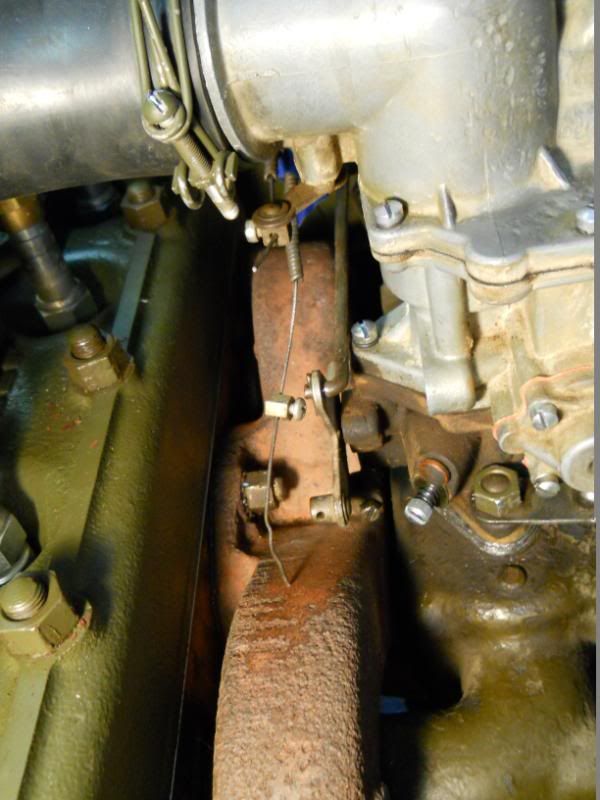
Next, the throttle: the cable coming from the throttle knob on the dash is connected to the cable that is on the left side of the pic by the "tab" with the hole in it. The mechanic says the cable is supposed to go through that hole and the screw lock holds it in place. The problem is he is worried the cable might get caught on something and lock the throttle open. He was wondering if there is supposed to be a mounting bracket or some sort of metal piece that guards the cable against the possibility of accidentally holding it open. If so, does anyone have a photo or drawing they can supply so we can make one?
Oh, forgot one thing, no data plate behind the passenger seat. See photo
The gage on the left is a very early M38/M37 unit with the added 95 Ohm resistor. It is actually a 6 volt gage and was installed by Willys in the early M38's with the resistor. It is a 0-120 PSI gage. The later M38 used an identical looking gage without the resistor that was a real 24 volt gage and was 0-120PSI. The Army eventually dropped both the early gages and went with the later M38A1 0-60 PSI gage that otherwise looked like the gage on the left without the 95 Ohm resistor. These gages must use the correct sender with them. 0-60 PSI vs 0-120 PSI sender.
The gage on the right is a late (1959 & up) M series gage designed to be used with the rubber type Packard connectors. It's connectors can be adapted for use with the early M38 type metal Douglas connectors. But you must insure you use it with the correct sender again 0-60 PSI vs 0-120 PSI.
If your M38 is MC17855 or older you should try to keep the early 95 OHM resistor and early gage.
The fast idle throttle control is suppose to just float thru that lever eye. You slide that screw stop off the cable. Then you slide that cable through the empty lever eye then you slide the screw stop back on the cable and with the carb throttle lever sitting at idle adjust the screw stop so it is about 1/8" away (forward) of the lever's eye. What you see is what you get.
Looks like someone stole your patent plate from the right rear wheel house.
Wes K:
Thanks for the information. I'll probably send this unit back and try to find the correct one. At least now I have the right information.
Will set the throttle cable as you suggested. Guess I'm without the rear data plate for this unit. Too bad.
The Army would have replaced any failed old 6V resistor gages with the newer 24 volt gage. If you want her to be original you can find the gages if you look hard enough.
The fuel gage DOES have the resistor on it but none of the other ones do. Since we just got everything in under the hood put back together, I'm not anxious to go back in to change the sending unit if I don't have to. Guess I'll look around for a pressure gage with the resistor. Today we will finally start he up and remove her from the lift to a high lift and grease all the points and do a final inspection of the underside without having to use a creeper.
Thanks again for the input.
Wes,
Thanks for the info. I cannot recall whether we used the old one or a new one. If I am still using the old 120 gage and we replaced the thermostat, I guess all I would have to do is find a 120 gage in 24 volt, right?
We dumped all the gear lubricants this afternoon and the transmission was the only one to have a very slight bit of moisture in it, probably from heating and cooling I would guess. All the rest was in good shape but if we're redoing the machine, might as well get it all done up front. I noticed a bracket on the left side underneath to the left of the transmission that is mounted on the frame and angles off to the left. It's about 4 inches long and has a hole at the end. It looks like a spring or something should be attached but there is no indication anything ever was there. I'll take a pic tomorrow and send it out in an effort to determine what it's for and if I'm missing something.
Thanks again.
Wes,
What pedal does this work with? I see the spring on your pic and since there is no spring connected to mine, I'm wondering what doesn't work on my jeep that should work.
UPDATE 1457 hrs cdt: the mechanic says it's for the brake system but I should not have to worry about it. Something about making sure the pedal returns when you let off the brake.
It's a lot different seeing the undercarriage with daylight than with the entire vehicle above it. Guess I won't need to take a pic of mine.
Thanks.
Your mechanic erred a bit. The spring needs to be hooked up. For you to properly adjust the pedal free play to insure it is releasing entirely the pressure on the master cylinder piston.