
How Tight are the brakes
-
Deadguy

- Jeep Enthusiast

- Posts: 776
- Joined: Wed Jun 08, 2011 6:00 pm
- Location: Bellmore, NY
- Contact:
How Tight are the brakes
On the M38A1? I don't expect them to be like a modern car, but there is a little travel before they kick in. I pump them twice, and they seem a little stiffer. That sounds like I should bleed the brakes, and I did, but they are still the same. They do stop the vehicle, and the pedal doesn't even go close to the floor.
1952 M38A1
Marine core reinforced rear bumper, military transistorized turn signal upgrade, arctic heater, 11" drum brakes, 200L PTO winch, Huffy overdrive, deep water fording kit, RT 68 vehicle mounted radio, Trac Locs front and rear.
www.danhenk.com
Marine core reinforced rear bumper, military transistorized turn signal upgrade, arctic heater, 11" drum brakes, 200L PTO winch, Huffy overdrive, deep water fording kit, RT 68 vehicle mounted radio, Trac Locs front and rear.
www.danhenk.com
-
spec4don

- Member
- Posts: 12
- Joined: Sat Jul 09, 2011 6:00 pm
-
Deadguy
- Jeep Enthusiast
- Posts: 776
- Joined: Wed Jun 08, 2011 6:00 pm
- Location: Bellmore, NY
- Contact:
umm...brake adjustment?
1952 M38A1
Marine core reinforced rear bumper, military transistorized turn signal upgrade, arctic heater, 11" drum brakes, 200L PTO winch, Huffy overdrive, deep water fording kit, RT 68 vehicle mounted radio, Trac Locs front and rear.
www.danhenk.com
Marine core reinforced rear bumper, military transistorized turn signal upgrade, arctic heater, 11" drum brakes, 200L PTO winch, Huffy overdrive, deep water fording kit, RT 68 vehicle mounted radio, Trac Locs front and rear.
www.danhenk.com
-
wesk

- Site Administrator

- Posts: 16467
- Joined: Sun Apr 03, 2005 6:00 pm
- Location: Wisconsin
- Contact:
If you are running silicon DOT 5 then a slightly soft pedal is what you get.
The brakes were designed to stop 2000 Lbs running about 50 MPH in a reasonable distance without any power assist. Their feel or lack of performance can only be compared to a similar non-power, older vehicle. If all your other vehicles or experience with other vehicles are modern power assist then they will feel like a lousy set of brakes.
Again the best source for your use to analyse your brakes is the service manual. Go to TM 9-8014 page 275 and read the brake chapter completely. Then bleed and adjust following the exact steps in that chapter.
Then road test it. At 50 MPH with no one behind you attempt a complete stop using only enough pedal (do not pump the pedal) to keep from skidding. If she comes to a stop withing 200 to 300 feet your in good shape.
The brakes were designed to stop 2000 Lbs running about 50 MPH in a reasonable distance without any power assist. Their feel or lack of performance can only be compared to a similar non-power, older vehicle. If all your other vehicles or experience with other vehicles are modern power assist then they will feel like a lousy set of brakes.
Again the best source for your use to analyse your brakes is the service manual. Go to TM 9-8014 page 275 and read the brake chapter completely. Then bleed and adjust following the exact steps in that chapter.
Then road test it. At 50 MPH with no one behind you attempt a complete stop using only enough pedal (do not pump the pedal) to keep from skidding. If she comes to a stop withing 200 to 300 feet your in good shape.
Wes K
45 MB, 51 M38, 54 M37, 66 M101A1, 60 CJ5, 76 DJ5D, 47Bantam T3-C & 5? M100
Mjeeps photo album: http://www.willysmjeeps.com/v2/modules. ... _album.php
45 MB, 51 M38, 54 M37, 66 M101A1, 60 CJ5, 76 DJ5D, 47Bantam T3-C & 5? M100
Mjeeps photo album: http://www.willysmjeeps.com/v2/modules. ... _album.php
-
Hawkshadow

- Jeep Enthusiast
- Posts: 310
- Joined: Tue Oct 09, 2012 6:00 pm
- Location: Toronto, Ontario, Canada
The drum brakes on these old jeeps are not automatically adjusting like you find in newer vehicles. As the pads wear, the distance between them and the drum increases. This increased distance creates "slack" in your pedal before the brakes engage the drum.
To correct this distance you have 2 brake adjusting eccentrics installed into each backing plate - one for each pad. Think of a bolt with a non-symmetrical head. As the brakes wear you have to adjust them to take up the slack.
** edit, I just noticed that you were inquiring about an A1. The above is how the brakes work on the M38, I am not familiar with any differences found on the A1 **
To correct this distance you have 2 brake adjusting eccentrics installed into each backing plate - one for each pad. Think of a bolt with a non-symmetrical head. As the brakes wear you have to adjust them to take up the slack.
** edit, I just noticed that you were inquiring about an A1. The above is how the brakes work on the M38, I am not familiar with any differences found on the A1 **
Jordan
M38 CDN
52-30718
M38 CDN
52-30718
-
wesk
- Site Administrator
- Posts: 16467
- Joined: Sun Apr 03, 2005 6:00 pm
- Location: Wisconsin
- Contact:
The A1 is similar but back plates and drums are different. The A1 brake shoes are full floating whereas the M38 brake shoes are anchored by adjustable eccentric pins at the bottom. Both have the middle level adjusting eccentrics.
It is in Dan's best interest to garner what he needs to know to adjust his brakes from the M38A1 service manual by reading it carefully himself before making any attempts to adjust his brakes.
It is in Dan's best interest to garner what he needs to know to adjust his brakes from the M38A1 service manual by reading it carefully himself before making any attempts to adjust his brakes.
Wes K
45 MB, 51 M38, 54 M37, 66 M101A1, 60 CJ5, 76 DJ5D, 47Bantam T3-C & 5? M100
Mjeeps photo album: http://www.willysmjeeps.com/v2/modules. ... _album.php
45 MB, 51 M38, 54 M37, 66 M101A1, 60 CJ5, 76 DJ5D, 47Bantam T3-C & 5? M100
Mjeeps photo album: http://www.willysmjeeps.com/v2/modules. ... _album.php
-
Hawkshadow
- Jeep Enthusiast
- Posts: 310
- Joined: Tue Oct 09, 2012 6:00 pm
- Location: Toronto, Ontario, Canada
-
Deadguy
- Jeep Enthusiast
- Posts: 776
- Joined: Wed Jun 08, 2011 6:00 pm
- Location: Bellmore, NY
- Contact:
I swapped my 9" stock drums with 11" Scout drums front and back. I'll email the guy who had them about adjustments.
1952 M38A1
Marine core reinforced rear bumper, military transistorized turn signal upgrade, arctic heater, 11" drum brakes, 200L PTO winch, Huffy overdrive, deep water fording kit, RT 68 vehicle mounted radio, Trac Locs front and rear.
www.danhenk.com
Marine core reinforced rear bumper, military transistorized turn signal upgrade, arctic heater, 11" drum brakes, 200L PTO winch, Huffy overdrive, deep water fording kit, RT 68 vehicle mounted radio, Trac Locs front and rear.
www.danhenk.com
-
wilfreeman
- Jeep Legend

- Posts: 1079
- Joined: Sun Mar 12, 2006 6:00 pm
- Location: Richburg, SC
- Contact:
Those should be self adjusting. You would still have to adjust the shoes fairly close to the drum when installing though.
Matt
1953 M38a1
1964 USMC M38a1
'51 USMC M100 trailer, '54 M100 trailer, '90 M101a1 trailer
Http://wilfreeman.wordpress.com (M38a1 build blog)
http://m38a1usmc.wordpress.com (USMC M38a1 rebuild blog)
1953 M38a1
1964 USMC M38a1
'51 USMC M100 trailer, '54 M100 trailer, '90 M101a1 trailer
Http://wilfreeman.wordpress.com (M38a1 build blog)
http://m38a1usmc.wordpress.com (USMC M38a1 rebuild blog)
-
wesk
- Site Administrator
- Posts: 16467
- Joined: Sun Apr 03, 2005 6:00 pm
- Location: Wisconsin
- Contact:
If they have the small thumb wheel at the bottom of the back plate you just adjust them tight till the wheel won't turn and then back off till the wheel turns with slight resistance. Depends on year of the Scout brake system. Most early 11" Scouts did not have auto-adjusters. You can tell by the shape of the teeth on the adjusting star wheel at the lower side of the back plate. If the teeth are symetrical they are manual adjusting only. If one side of each tooth is ramped then they are auto-adjusting. The auto-adjusting was simply a lever, cable and spring that reacted to motion when you backed up and slammed the brakes on the lever would bump the star wheel one click toward tighter. Either set-up is adjustable by turning the star wheel with a brake adjusting spoon or a large flat screw driver tip.
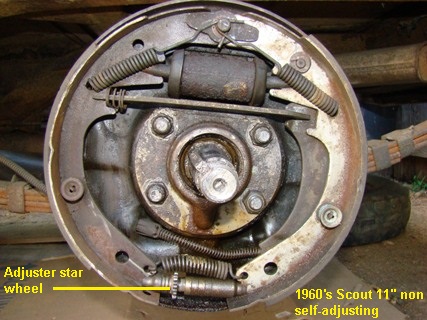
Non-self-adjusting Scout brake.
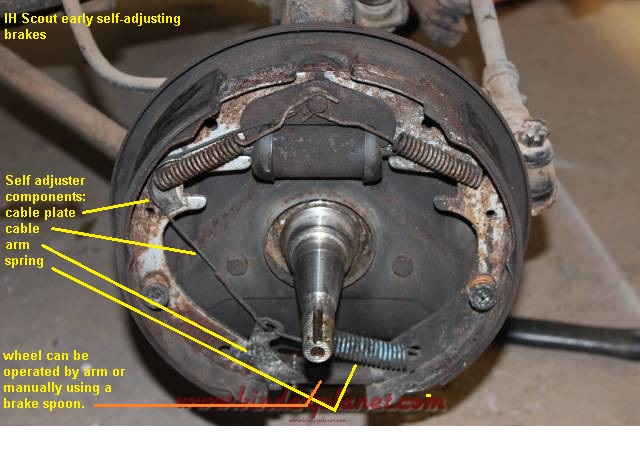
Self adjusting Scout drum brake. Non-self-adjusting will not have the curved plate, cable, lever.
If you still have the under the floor master cylinder then you still adjust your brake pedal free play per the TM 9-8014.
Which brake fluid are you using. DOT 3, DOT 4, or DOT 5?
Non-self-adjusting Scout brake.
Self adjusting Scout drum brake. Non-self-adjusting will not have the curved plate, cable, lever.
If you still have the under the floor master cylinder then you still adjust your brake pedal free play per the TM 9-8014.
Which brake fluid are you using. DOT 3, DOT 4, or DOT 5?
Last edited by wesk on Wed Oct 30, 2013 9:34 am, edited 2 times in total.
Wes K
45 MB, 51 M38, 54 M37, 66 M101A1, 60 CJ5, 76 DJ5D, 47Bantam T3-C & 5? M100
Mjeeps photo album: http://www.willysmjeeps.com/v2/modules. ... _album.php
45 MB, 51 M38, 54 M37, 66 M101A1, 60 CJ5, 76 DJ5D, 47Bantam T3-C & 5? M100
Mjeeps photo album: http://www.willysmjeeps.com/v2/modules. ... _album.php
-
RICKG
- Jeep Legend
- Posts: 1752
- Joined: Mon Aug 30, 2010 6:00 pm
- Location: SO IDAHO
Just for fun I found this on an earlier postwesk wrote:Which brake fluid are you using. DOT 3, DOT 4, or DOT 5?
http://importnut.net/brakefluid.htm
keep 'em rollin'
RICKG MC 51986 DOD 01-52, '50 CJ3a
RICKG MC 51986 DOD 01-52, '50 CJ3a
-
skyjeep50
- Jeep Enthusiast
- Posts: 606
- Joined: Mon Feb 19, 2007 6:00 pm
- Location: Illinois
Back to your original question - my M38A1's brakes feel "hard" compared to a modern car's brakes. I went through replacing hoses, DOT 3 and adjusting the brake pads to spec this past summer. There is not much movement in the brake pedal when everything is to spec and, yes, you have to push harder in comparison to modern car's brakes to get the same braking action. That's the feeling of non-boosted 1950's brakes!
1951 M38
-
wesk
- Site Administrator
- Posts: 16467
- Joined: Sun Apr 03, 2005 6:00 pm
- Location: Wisconsin
- Contact:
Good article Rick. It keeps it simple.
Brake Fluid Basics
http://importnut.net/brakefluid.htm
Top of Form
If you are in a giving mood
Bottom of Form
(This article was obtained from the Honda Performance List)
By Steve Wall
As a former materials engineering supervisor at a major automotive brake system supplier, I feel both qualified and obligated to inject some material science facts into the murky debate about DOT 5 verses DOT 3-4 brake fluids. The important technical issues governing the use of a particular specification brake fluid are as follows:
Fluid compatibility with the brake system rubber, plastic and metal components. Water absorption and corrosion. Fluid boiling point and other physical characteristics. Brake system contamination and sludging. Additionally, some technical comments will be made about the new brake fluid formulations appearing on the scene.
First of all, it's important to understand the chemical nature of brake fluid. DOT 3 brake fluids are mixtures of glycols and glycol ethers. DOT 4 contains borate esters in addition to what is contained in DOT 3. These brake fluids are somewhat similar to automotive anti-freeze (ethylene glycol) and are not, as Dr. Curve implies, a petroleum fluid. DOT 5 is silicone chemistry.
Fluid Compatibility
Brake system materials must be compatible with the system fluid. Compatibility is determined by chemistry, and no amount of advertising, wishful thinking or rationalizing can change the science of chemical compatibility. Both DOT 3-4 and DOT 5 fluids are compatible with most brake system materials except in the case some silicone rubber external components such as caliper piston boots, which are attacked by silicon fluids and greases.
Water absorption and corrosion
The big bugaboo with DOT 3-4 fluids always cited by silicone fluid advocates is water absorption. DOT 3-4 glycol based fluids, just like ethylene glycol antifreezes, are readily miscible with water. Long term brake system water content tends to reach a maximum of about 3%, which is readily handled by the corrosion inhibitors in the brake fluid formulation. Since the inhibitors are gradually depleted as they do their job, glycol brake fluid, just like anti-freeze, needs to be changed periodically. Follow BMW's recommendations. DOT 5 fluids, not being water miscible, must rely on the silicone (with some corrosion inhibitors) as a barrier film to control corrosion. Water is not absorbed by silicone as in the case of DOT 3-4 fluids, and will remain as a separate globule sinking to the lowest point in the brake system, since it is more dense.
Fluid boiling point DOT 4 glycol based fluid has a higher boiling point (446F) than DOT 3 (401F), and both fluids will exhibit a reduced boiling point as water content increases. DOT 5 in its pure state offers a higher boiling point (500F) however if water got into the system, and a big globule found its way into a caliper, the water would start to boil at 212F causing a vapor lock condition [possible brake failure -ed.]. By contrast, DOT 3 fluid with 3% water content would still exhibit a boiling point of 300F. Silicone fluids also exhibit a 3 times greater propensity to dissolve air and other gasses which can lead to a "spongy pedal" and reduced braking at high altitudes.
DOT 3 and DOT 4 fluids are mutually compatible, the major disadvantage of such a mix being a lowered boiling point. In an emergency, it'll do. Silicone fluid will not mix, but will float on top. From a lubricity standpoint, neither fluids are outstanding, though silicones will exhibit a more stable viscosity index in extreme temperatures, which is why the US Army likes silicone fluids. Since few of us ride at temperatures very much below freezing, let alone at 40 below zero, silicone's low temperature advantage won't be apparent. Neither fluids will reduce stopping distances.
With the advent of ABS systems, the limitations of existing brake fluids have been recognized and the brake fluid manufacturers have been working on formulations with enhanced properties. However, the chosen direction has not been silicone. The only major user of silicone is the US Army. It has recently asked the SAE about a procedure for converting from silicon back to DOT 3-4. If they ever decide to switch, silicone brake fluid will go the way of leaded gas.
Brake system contamination
The single most common brake system failure caused by a contaminant is swelling of the rubber components (piston seals etc.) due to the introduction of petroleum based products (motor oil, power steering fluid, mineral oil etc.) A small amount is enough to do major damage. Flushing with mineral spirits is enough to cause a complete system failure in a short time. I suspect this is what has happened when some BMW owners changed to DOT 5 (and then assumed that silicone caused the problem). Flushing with alcohol also causes problems. BMW brake systems should be flushed only with DOT 3 or 4.
If silicone is introduced into an older brake system, the silicone will latch unto the sludge generated by gradual component deterioration and create a gelatin like goop which will attract more crud and eventually plug up metering orifices or cause pistons to stick. If you have already changed to DOT 5, don't compound your initial mistake and change back. Silicone is very tenacious stuff and you will never get it all out of your system. Just change the fluid regularly. For those who race using silicone fluid, I recommend that you crack the bleed screws before each racing session to insure that there is no water in the calipers.
New developments
Since DOT 4 fluids were developed, it was recognized that borate ester based fluids offered the potential for boiling points beyond the 446F requirement, thus came the Super DOT 4 fluids - some covered by the DOT 5.1 designation - which exhibit a minimum dry boiling point of 500F (same as silicone, but different chemistry).
Additionally, a new fluid type based on silicon ester chemistry (not the same as silicon) has been developed that exhibits a minimum dry boiling point of 590F. It is miscible with DOT 3-4 fluids but has yet to see commercial usage.
Wes K
45 MB, 51 M38, 54 M37, 66 M101A1, 60 CJ5, 76 DJ5D, 47Bantam T3-C & 5? M100
Mjeeps photo album: http://www.willysmjeeps.com/v2/modules. ... _album.php
45 MB, 51 M38, 54 M37, 66 M101A1, 60 CJ5, 76 DJ5D, 47Bantam T3-C & 5? M100
Mjeeps photo album: http://www.willysmjeeps.com/v2/modules. ... _album.php
-
Deadguy
- Jeep Enthusiast
- Posts: 776
- Joined: Wed Jun 08, 2011 6:00 pm
- Location: Bellmore, NY
- Contact:
I put Dot 3 in my system Wes. My buddy Chris, who did master cylinder swap for me when he changed the clutch at his shop, might have used Dot 5, I'll ask him. The brake drums are self adjusting. Th pedal doesn't really feel "spongy" or "soft". It just travels maybe an inch before the brakes grab. When they grab tho, it's stiff and firm. I don't expect them to be like new brakes-I always gives the cars in front of me plenty of leeway. I just want to make sure I iron out any problems. Until the snow kicks in, I drive this vehicle all the time.
1952 M38A1
Marine core reinforced rear bumper, military transistorized turn signal upgrade, arctic heater, 11" drum brakes, 200L PTO winch, Huffy overdrive, deep water fording kit, RT 68 vehicle mounted radio, Trac Locs front and rear.
www.danhenk.com
Marine core reinforced rear bumper, military transistorized turn signal upgrade, arctic heater, 11" drum brakes, 200L PTO winch, Huffy overdrive, deep water fording kit, RT 68 vehicle mounted radio, Trac Locs front and rear.
www.danhenk.com