


I get the feeling you are not quite up to tackling this in depth adjusting regimen or you are becoming tired of the intricate maneuvering that must be accomplished. There is certainly not enough room here to conduct an in depth DC electrical systems orientation. At any rate I must emphasize the importance of using the correct terminology consistently in this subject area to avoid serious errors. You have three components on the regulator that are adjustable. The circuit breaker is adjusted to open at a certain voltage and close at a certain voltage. This unit is independent of the other two components. You have a current regulator that is adjustable to a maximum allowable current value. This adjustment requires an amp meter capable of measuring 25 to 30 amps. Most small Fluke VOM's can only handle several milliamps. There are rather expensive range expanders available for them. The carbon pile rheostat or lamp load set are tools used to apply a load of a known value to the system. These are needed both to set the maximum allowable amperage flow through the current regulator and to assist with the adjusting of the third component of the regulator which is the voltage regulator unit.
[quote]
1-Are both the voltage and ammeter armature screws adjusted back and forth until satisfactory readings are obtained?
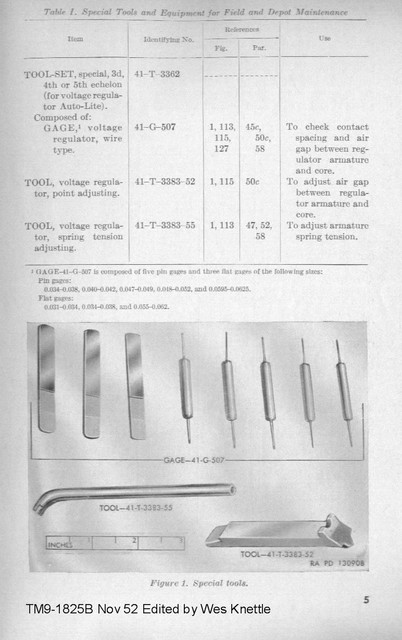
The voltage regulator and current regulator armature spring screws are adjusted when an adjustment is called for by the readings you observe when that unit is being tested. You loosen the lock nut if present and turn the shaft.
2-If the voltage screw is adjusted, then does the ammeter armature have to retested and readjusted in turn?
Yes sometimes.
3-What is a carbon pile load rheostat or lamp bank? (I thought a rheostat was used to adjust voltage supply to equipment, IE motor)
They are a tool that will provide an artificial load on the system.
4-How is the current adjusted to half by changing the load rheostat or lamp bank?
Actually a simple resistance adjusting rheostat is used to increase or decrease the field signal which in turn will increase or decrease the current flow from the generator. We use this to adjust the current flow to 1/2 of the system's normal capacity of 25 amps or 12.5 amps. Then we adjust system voltage to 28.0 while the system is operating in the middle of it's range.
5-How are the current readings taken with a standard fluke multimeter, instead of the military multi connection meter set?
By inserting the amp meter (capable of at least 25 amps) in series with the wire #4.
6-Is this process supposed to be done with the engine running the whole time, and no batteries connected?
No. The engine is running with batteries connected for the majority of tests. The engine is off or the battery disconnected during adjustments.
7-Is the test cable supposed to be plugged in between the regulator and the jeep harness?
Yes they are. You must have a means to interrupt the cable connections. Most of us use the adapter test lead sets provided by the Army. These facilitate opening a circuit and/or accessing a test point.
8-Can needle nose pliers be used to adjust the nut? It seems that this nut just loosens or tightens the contact spring. How can this adjust the voltage?
The armature spring tension determines when the contacts will open or close. These contacts are constantly and very rapidly opening and closing during system operation. The tool you select should not cause damage to anything.
[/quote

Test lead adapter kit.


 I also know several other folks that can and do.


