Braking problem-Low brake force

Discussion topics on Willys Overland M series vehicles
User avatar
Kenk
Member
Posts: 24
Joined: Sat Jan 10, 2009 6:00 pm
Location: New Jersey

Braking problem-Low brake force

Post by Kenk »

:?: 51 M38 I am having a problem getting enough brake force to stop the vehicle. When I orginally replaced the whole system it included a rebuild of the master cylinder, installation of new wheel cylinders, installation all new lines and new shoes. I bled the system and had no air coming out of the cylinders just fluid after several attempts(it took a while to purge the system). After this was done I road tested her and it took way too much time to stop. To the point where I was wondering if the shoes where even making contact with the drum. Last week I cut all the drums and reset the shoes to the .005 & .008 setting with a feeler gage and still am having the same issue. I am using silicone brake fluid at this time. I did not bench bleed the M.S. but thought if I had fluid coming out of each wheel cylinder that it should have been OK. Now Im back to thinking the master cylinder is no good. Any thoughts or direction? Its a simple brake system and I am starting to overthink things.

Thanks Ken
User avatar
Ryan_Miller
Site Administrator
Site Administrator
Posts: 1686
Joined: Sat Apr 02, 2005 6:00 pm
Location: Kansas

Post by Ryan_Miller »

Bench bleed the master cylinder.

What I did:

Bench bleed the master cylinder, let it set for a few hours to make sure any microbubles were consolidated.

Bench bleed again to make sure. Then hook up the system and bleed the brakes. I had great pressure. The next day I rebled them at the wheel cylinders again to make sure.

Bleeding the master cylinder is a must on these vehicles no matter what type of fluid you are using. 8)
Ryan Miller
MVPA # 22010
User avatar
wesk
Site Administrator
Site Administrator
Posts: 16471
Joined: Sun Apr 03, 2005 6:00 pm
Location: Wisconsin
Contact:

Post by wesk »

Two of my favorite reasons for not wasting good money on silicon brake fluid!

1-It's very difficult to bleed because the silicon entraps air pockets and it takes almost a complete transfusion evry time to bleed all the trapped air out.

2-The silicon fluid has a higher level of sponginess caused by all these trapped air pockets.

3-Since it is not capable of absorbing moisture it allows the moisture to remain in tact and seperate and since the moisture is heavier it settles to the bottom areas of the brake system causing corrosion of those areas.

The only reason the military adopted silicon fluid was to satisfy the money lining needs of a few government official's pockets.
Wes K
45 MB, 51 M38, 54 M37, 66 M101A1, 60 CJ5, 76 DJ5D, 47Bantam T3-C & 5? M100

Mjeeps photo album: http://www.willysmjeeps.com/v2/modules. ... _album.php
User avatar
Ryan_Miller
Site Administrator
Site Administrator
Posts: 1686
Joined: Sat Apr 02, 2005 6:00 pm
Location: Kansas

Post by Ryan_Miller »

Wes,

Silicone brake fluid is fully capable and a good fluid.

It is a better fluid for antique automobiles that don't get driven much.

It is not hard to bleed the brakes, it just takes a little time.

The pedal in mine is not spongey.

You would need to have a lot of moisture to cause the corrosion you are talking about and moisture causes just as much trouble in the other DOT fluids.

I feel that you are wrong, but then again we have seen this discussion time and again.

Whatever brake fluid you use, you should flush the system every few years.

Have a nice day! 8) :D
Ryan Miller
MVPA # 22010
User avatar
wesk
Site Administrator
Site Administrator
Posts: 16471
Joined: Sun Apr 03, 2005 6:00 pm
Location: Wisconsin
Contact:

Post by wesk »

Here is one place we disagree.

I will never use silicon brake fluid in any of my vehicles.

If you support fluid changes every few years then in your own words neither has any advantage over the other.
The difference is at the end of two years the water in the DOT 3 is still absorbed and suspended in the DOT3 and the water in the silicon has been lying at the bottom of the system for two years causing rust.

Science and engineering has clearly documented the compressibility of the DOT 5 silicon is greater than DOT 3 and DOT 4. This means spongy pedal period for DOT5 when compared to DOT 3 & 4.

Science and engineering have clearly documented the DOT 5 silicon suspends and entraps air molecularly and this is virtually impossible to remove completely and results in the compressability and spongy pedal. Simple line and cylinder bleeding does not remove air that is combined in the silicon moleculary.
Closeness to exhaust system part exasperates this problem.

For these reasons the major car companies tried DOT 5 for 2 or 3 years in the early 70's and dropped it and went back to DOT 3.

Why the military is using it still is absolutely nonsense and can only be political.
Wes K
45 MB, 51 M38, 54 M37, 66 M101A1, 60 CJ5, 76 DJ5D, 47Bantam T3-C & 5? M100

Mjeeps photo album: http://www.willysmjeeps.com/v2/modules. ... _album.php
User avatar
Cacti_Ken
Jeep Legend
Jeep Legend
Posts: 1021
Joined: Tue Apr 19, 2005 6:00 pm
Location: Silsbee, Texas

Post by Cacti_Ken »

I use DOT 3. Everything in my breaking system is new. From the MC to the lines, wheel cylinders, brake shoes and drums. I was and I am still disappointed in their performance. I have a very good pedal, not spongy. It is impossible to lock up the wheels. But then again maybe they are not suspose to lock up. I don't think the mechanical design of this model braking system was very good. However probably served it's purpose in the field.

I recall back in the early sixties when I took my drivers liscense test and the officer made me do a quick stop at slow speed He almost went thru the windshield with those brake systems. and they weren't power brakes either.
Tropical Veteran
35th Inf. Reg. "CACTI" 4th I.D. VN
Amateur Radio K5XOM
User avatar
wesk
Site Administrator
Site Administrator
Posts: 16471
Joined: Sun Apr 03, 2005 6:00 pm
Location: Wisconsin
Contact:

Post by wesk »

Every jeep I've owned since 1970 has been able to lock up the wheels and slide to stop. Usually after I rebuilt the brakes. Adjustment is very odd procedure and if not done right you will never get enough travel of the shoe to engage the drum tight enough to lock her up. Also if you use drums that have been turned you must shim your shoes accordingly or you will not get adequate travel. The most powerful hydraulic system in the world can only move something as far as it's travel limit. Also correct seasoning or breaking in of the shoe material is also needed. As Ken mentions this is a very old design which was not intended for freeway stopping and when we try to operate these in freeway traffic we learn very quick that heat is the enemy and it builds up fast on two or three heavy applications from 50 plus MPH in traffic resulting in serious fade.

A driver should have a dual master cylinder and latest 9" and preferably 11" drum brakes.
Wes K
45 MB, 51 M38, 54 M37, 66 M101A1, 60 CJ5, 76 DJ5D, 47Bantam T3-C & 5? M100

Mjeeps photo album: http://www.willysmjeeps.com/v2/modules. ... _album.php
User avatar
Ryan_Miller
Site Administrator
Site Administrator
Posts: 1686
Joined: Sat Apr 02, 2005 6:00 pm
Location: Kansas

Post by Ryan_Miller »

Wes,

I have used DOT 5 in several vehicles and the mustang club I belong to here, which has over 1000 members advocates DOT 5 fluid.

Nobody I have talked to has a spongey pedal.

I don't have a spongey pedal. Getting the air out of the DOT 5 fluid is extremely simple, let it set for a few hours and the bubbles will be gone.


SCIENCE has shown that both fluids will get CORROSION when moisture is in the system over time.

SCIENCE has shown that there are fewer brake problems and less paint damaged when older vehicles that set and are not driven daily are using DOT 5.

This is an academic argument with no end and a matter of personal preference.

I have used both and don't see much of an advantage of one over the other except that DOT 5 will NOT damage paint and it can be dumped without enviromental hazard problems. (NONTOXIC to people and animals).

Sincerely and Respcectfully,

Good day 8) :D :wink:
Ryan Miller
MVPA # 22010
User avatar
wesk
Site Administrator
Site Administrator
Posts: 16471
Joined: Sun Apr 03, 2005 6:00 pm
Location: Wisconsin
Contact:

Post by wesk »

I'll have to pull a Joel Gopan here and say:

As a long time mechanic 1964 til, I will state my preference is the fluid that has the least problems in the vehicle I wish to use it in and that fluid is DOT's 3 & 4. :wink:
Wes K
45 MB, 51 M38, 54 M37, 66 M101A1, 60 CJ5, 76 DJ5D, 47Bantam T3-C & 5? M100

Mjeeps photo album: http://www.willysmjeeps.com/v2/modules. ... _album.php
User avatar
Kenk
Member
Posts: 24
Joined: Sat Jan 10, 2009 6:00 pm
Location: New Jersey

Post by Kenk »

Wes and Ryan,

I hope I did not open up too much on the subject of the "proper" type of fluid to be used. That was not my intent as I have seen that this issue has been discussed in length before. For now, since I have already have the DOT 5 silicon fluid in the system, I will try to work with it. Can you direct me to the proper procedure for "bench" bleeding the MS on the M38. Is it in the TM? I want to take your reccomendation to do this before going any further. If this does not work then based on what Wes is saying, I may have a set of drums that are too far worn out. Do you have a recommended source for these drums if I have to replace them? I know AJP has some good pricing.

Thanks again,

Ken
User avatar
Ryan_Miller
Site Administrator
Site Administrator
Posts: 1686
Joined: Sat Apr 02, 2005 6:00 pm
Location: Kansas

Post by Ryan_Miller »

Bench bleeding should be done when using any brake fluid.

Get a 4 inch piece of steel brake line and hook one end up to the brass Y that splits the front brakes from the rear brakes.

On the other end of this 4 inch piece place small clear plastic tubing (you can get from Ace hardware) over the end of the metal line.

Run the clear tubing back into the master cylinder via the fill hole on top.

Gently pump the brake pedal, watching the clear plastic line for air bubbles. Do this for a few minutes to make sure you get all the bubbles out.

I waited a couple of hours and then did it again to make sure.

Now hook the brake lines back up and then bleed the system.
Ryan Miller
MVPA # 22010
User avatar
wesk
Site Administrator
Site Administrator
Posts: 16471
Joined: Sun Apr 03, 2005 6:00 pm
Location: Wisconsin
Contact:

Post by wesk »

Proper bench bleeding is done on the bench before the master cylinder is installed it is filled with fluid. A hose is then attached to the output port and run into the reservoir as Ryan mentioned above then you operate the plunger full stroke slowly until there are no more bubbles.

Yes this can also be done in the jeep but there must be no way that air can be sucked in the output port when the plunger is released. With Ryan's setup above he is assuming there is no air in the other brake line he left connected to the "Y". It is better you go back to the outlet port itself and connect one hose to the only hole and run it into the reservoir.

When folks insist on having DOT 5 in their systems I recommend they use a pressure pot bleeder on the entire system. Also when handling the can of DOT 5 try to avoid airating the fluid by splashing, shaking the can, and pouring roughly.
Wes K
45 MB, 51 M38, 54 M37, 66 M101A1, 60 CJ5, 76 DJ5D, 47Bantam T3-C & 5? M100

Mjeeps photo album: http://www.willysmjeeps.com/v2/modules. ... _album.php
User avatar
maeserik
Active Member
Active Member
Posts: 226
Joined: Tue Jun 13, 2006 6:00 pm
Location: Wijnegem Belgium Europe
Contact:

Post by maeserik »

I did the bench bleeding on the jeep, i let escape the air from the mc by the brakeswitch at the back. A few shots on the pedal with a ful filled MC.

Then i blead the whole system. After a 200 miles i readjust the brakeshoes as good as possible, with just free turning wheels.
From that time the brakes stayed good. In the beginning they need some adjustment after a short use time.That was in 2006 and since than i never touched a thing. The jeep stops fine, with a hard pedal. I planned to renew the dot4 fluid this summer as precaution.

On my son's GPW we did it the same way, and this jeep brakes even better. I was told not to use dot 5, it absorbs no water and possible water can stay as a bubbles and rust things up. This wat I heard ...

Erik
1942 GPW 71336 my son's jeep restored now
1951 M38 MC11891
1953 VW beetle (genuine german Käfer )
1957 fantastic wife

http://www.surfacezero.com/g503/showgal ... p?cat=1865

and this webside
User avatar
Ryan_Miller
Site Administrator
Site Administrator
Posts: 1686
Joined: Sat Apr 02, 2005 6:00 pm
Location: Kansas

Post by Ryan_Miller »

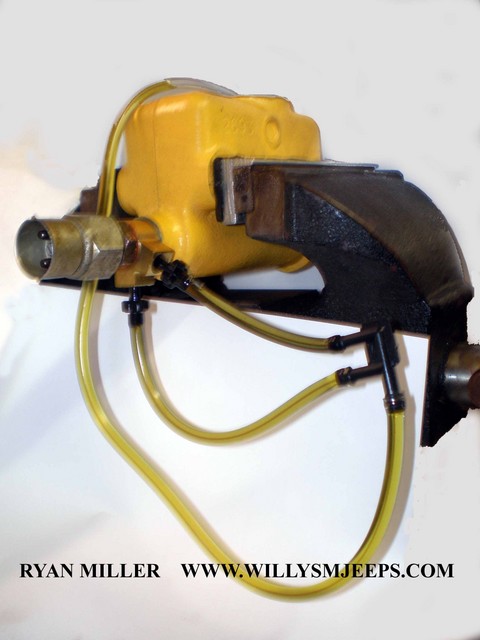
Since a photo is worth a thousand words, here is a photo of the bench bleed system I was talking about.

This can be done on the vehicle as well.

Note that this loops the fluid back into the reservoir. It is part of a self bleed kit that sells for under $5.00 at any auto parts store.

With this photo you can also see that there are no bubbles in the DOT 5 Fluid. :lol:

I hope this further clarifies our discussion. :)

To all a great and happy day. :D

Image
Ryan Miller
MVPA # 22010
User avatar
wesk
Site Administrator
Site Administrator
Posts: 16471
Joined: Sun Apr 03, 2005 6:00 pm
Location: Wisconsin
Contact:

Post by wesk »

Ryan,
Your earlier description of bench bleeding in the jeep
Get a 4 inch piece of steel brake line and hook one end up to the brass Y that splits the front brakes from the rear brakes.

On the other end of this 4 inch piece place small clear plastic tubing (you can get from Ace hardware) over the end of the metal line.

Run the clear tubing back into the master cylinder via the fill hole on top.
Leaves one leg of the brass "Y" still connected to either the front or rear brake plumbing. This is the point I questioned as not insuring that other line does not become a source of air to get sucked when the pedal is released after each pump.

When all of this is done the only item not bleed yet is the brake switch which can be done by pumping the pedal up and holding it then break the switch loose a turn or so just as you would a bleeder fitting and quickly tighten it up before the pedal is released.

Most new and rebuilt master cylinder kits come with the two bench bleeding hoses (dual masters use two) and a sheet of paper explaining the correct procedure.
Wes K
45 MB, 51 M38, 54 M37, 66 M101A1, 60 CJ5, 76 DJ5D, 47Bantam T3-C & 5? M100

Mjeeps photo album: http://www.willysmjeeps.com/v2/modules. ... _album.php
Post Reply