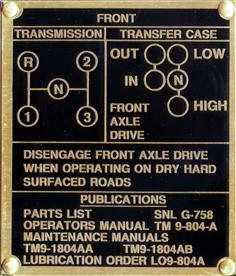
I have been getting conflicting advice on flat towing my M38A1. Some say to keep the transfer case in neutral (N) and other say to keep in HIGH. What say you?
Of course, the manual tranny stays in neutral and the front drive in "Out."
Only planning to tow maybe 40 miles one-way at ~50 mph, to parades, shows, and memorial services.
I throw my M38 up on a UHaul 6x12 open utility trailer and pull it up to 100 miles or more. The trailer can handle the weight, is cheap, and saves wear and tear on the jeep.
This was a suggestion I got from an old friend who's had these and MB jeeps all his life and worked in construction. It has worked out well.
1-The best arrangement for flat towing is 4 free wheeling hubs and the rest is not important. Yes the rear axle can be modified for locking hubs.
2-Another very safe method is to disconnect the drive shafts at the axle pinions.
3-Lockout hubs front and disconnect rear drive shaft at axle pinion.
(1, 2 & 3 would allow unlimited traveling and only modest speeds up to 70.)
4-Lockout hubs front , tranny in neutral and transfer in neutral.
5-Stock hubs front, tranny in neutral and transfer in neutral.
(4 & 5 will allow safe hauling in the 300-400 mile range at speeds not above 60.)
I have heard several off the wall explanations that try to substantiate leaving the transfer in high. I disagree because with the transfer in high you will also be turning the tranny output shaft without benefit of splash oil lube from the rest of the tranny gears.
Keep in mind that all gear boxes are designed to apply the power from the engine to the tire. When you apply the turning power to the tire and work your way back to the engine you will induce abnormal wear on parts.
Thus my rule has always been above 300 miles use a trailer and if speeds are intended to be 70 or more use a trailer.
Additional precautions when flat towing are:
1-secure the steering wheel allowing only 20 degrees or so of travel.
2-Make darn sure the tow bar is higher at the tow vehicle's hitch then it is at the jeep's bumper.
3-Make darn sure wheel bearings are well lubed and in good shape.
4-Make sure the steering linkage does not have excessive play. Excess slop will have the jeep trying to change lanes behind you above 45 MPH.
6-Use a "Vehicle in Tow" sign on the back of the jeep. There's a ton of inexperienced and ignorant drivers out there that will not notice the tow vehicle and will tailgate the jeep real close.
7-If the jeep's rear lights cannot be hooked to the trailer light system of the tow vehicle because of different voltages then be sure to use the clamp-on or magnet mount trailering lights.