
I've been trying to get the bugs worked out of my 1952 M38 jeep. Everything has been replaced with new or refurbished. The carb is the YS and has been dipped and rebuilt using a quality kit from Midwest. When it wasn't working properly I sent it to Competition carbueration in Nevada. He said the fuel is not same as it used to be and have worked on them before. The problem is the motor is not getting enough fuel because it relys on the vacuum of the motor for fuel. So I think the carb should be good ( not plugged up or garbage somewhere it shouldn't be). The cooling system is new, thermostat is a ~170 degree reading on mechanical gauge. Should I go to another style/type of carb? Have others had this problem before? It idles nice but when you ask it to go down the road it sputters like it's not getting enough fuel. Eventually it will run OK, but it takes 5 miles of running and only with the throttle cable 1/2 out. I will drain the tank at a later time as a last result and try a higher grade.
Thanks Rusty
Which carburetor to use
-
Bobber

- Active Member

- Posts: 178
- Joined: Sat Feb 08, 2014 6:00 pm
- Location: Tri Cities, Washington
-
4x4M38

- Jeep Legend

- Posts: 3487
- Joined: Thu May 29, 2014 6:00 pm
- Location: Texas Hill Country
Rusty,
Sorry for your troubles.
There are many questions your post brings up as well
as a comment or two.
First, the standard military fuel pump should perform as
designed no matter if it is using heritage leaded fuel or
modern no lead /ethanol fuel. The mechanic's comments do not make sense.
The pump is a mechanical diaphragm pump which should pump
gasoline if it has sufficient head from the tank. The vacuum is a secondary
source and is not critical to the pump supplying fuel to the carb.
A fuel pump problem may be the issue but I'd bet it is elsewhere.
I'd start with the troubleshooting section of your manual.
Just my guess but I suspect the tank filter or a problem with
the carburetor, float, or accelerator pump.
The other thing that comes to mind is your comment regarding
it will only run well after five miles with the throttle cable
half out. The throttle cable should not be used for running down the highway
at speed, sparingly off road in low gear, and usually for warming
up the motor while parked.
The only other thing that comes to mind is if the choke is partially closed
it will perform as you suggest. Wondering if your cables are mixed up.
As I say, look at the troubleshooting portions of the manuals
available for download for free here on the website.
Good luck,
Sorry for your troubles.
There are many questions your post brings up as well
as a comment or two.
First, the standard military fuel pump should perform as
designed no matter if it is using heritage leaded fuel or
modern no lead /ethanol fuel. The mechanic's comments do not make sense.
The pump is a mechanical diaphragm pump which should pump
gasoline if it has sufficient head from the tank. The vacuum is a secondary
source and is not critical to the pump supplying fuel to the carb.
A fuel pump problem may be the issue but I'd bet it is elsewhere.
I'd start with the troubleshooting section of your manual.
Just my guess but I suspect the tank filter or a problem with
the carburetor, float, or accelerator pump.
The other thing that comes to mind is your comment regarding
it will only run well after five miles with the throttle cable
half out. The throttle cable should not be used for running down the highway
at speed, sparingly off road in low gear, and usually for warming
up the motor while parked.
The only other thing that comes to mind is if the choke is partially closed
it will perform as you suggest. Wondering if your cables are mixed up.
As I say, look at the troubleshooting portions of the manuals
available for download for free here on the website.
Good luck,
-
Bobber
- Active Member
- Posts: 178
- Joined: Sat Feb 08, 2014 6:00 pm
- Location: Tri Cities, Washington
-
wesk

- Site Administrator

- Posts: 16466
- Joined: Sun Apr 03, 2005 6:00 pm
- Location: Wisconsin
- Contact:
Please note I have asked you a few questions to verify your info by entering them within your quoted post in bold italics.
Ok, now for the most likely cause of your problem. It takes engine intake manifold vacuum (suction) for the metering rod to and the accelerator pump to function properly. What do the do when they function properly? The metering rod allows more fuel to feed as you give it more throttle. The accelerator pumps introduces additional fuel as you add pedal to make the transition from idle to faster more smooth. Since you currently have an issue with low engine vacuum they are not meeting the demand for more fuel and your engine stumbles when you try to accelerate. When you pull the choke halfway out you actually increase the fuel supply be reducing the amount of air it is mixed with. So now lets see where you can be loosing vacuum and why it seems to improve once the engine warms up completely.
The most likely culprit is a leaking intake manifold gasket. We check this out using a propane enrichment test. You use a propane bottle and open the valve slightly but do not light it. With the engine running rough aim the propane at the intake gaskets IE carb base gasket, individual intake runner gaskets at the block. If there is a leak when the propane gets sucked into the leak the engine will begin to run smoothly. Don't overlook the possibility that the intake manifold may have a crack or two in it. It may be where you can see it or it may be facing inside the heat sump box for the heat riser system. Sometimes we overlook the need to machine an M38 intake/exhaust combo manifold together as an assembly to ensure they fit all intake and exhaust ports evenly to the block.
Rather then confuse things any further, check this possibility out first and if you still have a problem post the need for additional help here and be sure to let us know what you find.
YesI've been trying to get the bugs worked out of my 1952 M38 jeep. Everything has been replaced with new or refurbished. The carb is the YS and has been dipped and rebuilt using a quality kit from Midwest. Were all the passageway plugs removed and passageways cleaned? When it wasn't working properly I sent it to Competition carbueration in Nevada. He said the fuel is not same as it used to be and have worked on them before.Has he sent the carb back to you with this as the only explanation for what the problem could be? The problem is the motor is not getting enough fuel because it relies on the vacuum of the motor for fuel. What that shop meant here is that the carb metering rod and accelerator pump relies on engine manifold vacuum to function. That is what the two small rubber diaphragms in your rebuild kit were for. So I think the carb should be good ( not plugged up or garbage somewhere it shouldn't be). The cooling system is new, thermostat is a ~170 degree reading on mechanical gauge. Should I go to another style/type of carb? No. You should fix the problem. Have others had this problem before? Yes It idles nice but when you ask it to go down the road it sputters like it's not getting enough fuel. Eventually it will run OK, but it takes 5 miles of running and only with the choke cable 1/2 out. I will drain the tank at a later time as a last result and try a higher grade.
Ok, now for the most likely cause of your problem. It takes engine intake manifold vacuum (suction) for the metering rod to and the accelerator pump to function properly. What do the do when they function properly? The metering rod allows more fuel to feed as you give it more throttle. The accelerator pumps introduces additional fuel as you add pedal to make the transition from idle to faster more smooth. Since you currently have an issue with low engine vacuum they are not meeting the demand for more fuel and your engine stumbles when you try to accelerate. When you pull the choke halfway out you actually increase the fuel supply be reducing the amount of air it is mixed with. So now lets see where you can be loosing vacuum and why it seems to improve once the engine warms up completely.
The most likely culprit is a leaking intake manifold gasket. We check this out using a propane enrichment test. You use a propane bottle and open the valve slightly but do not light it. With the engine running rough aim the propane at the intake gaskets IE carb base gasket, individual intake runner gaskets at the block. If there is a leak when the propane gets sucked into the leak the engine will begin to run smoothly. Don't overlook the possibility that the intake manifold may have a crack or two in it. It may be where you can see it or it may be facing inside the heat sump box for the heat riser system. Sometimes we overlook the need to machine an M38 intake/exhaust combo manifold together as an assembly to ensure they fit all intake and exhaust ports evenly to the block.
Rather then confuse things any further, check this possibility out first and if you still have a problem post the need for additional help here and be sure to let us know what you find.
Wes K
45 MB, 51 M38, 54 M37, 66 M101A1, 60 CJ5, 76 DJ5D, 47Bantam T3-C & 5? M100
Mjeeps photo album: http://www.willysmjeeps.com/v2/modules. ... _album.php
45 MB, 51 M38, 54 M37, 66 M101A1, 60 CJ5, 76 DJ5D, 47Bantam T3-C & 5? M100
Mjeeps photo album: http://www.willysmjeeps.com/v2/modules. ... _album.php
-
Bobber
- Active Member
- Posts: 178
- Joined: Sat Feb 08, 2014 6:00 pm
- Location: Tri Cities, Washington
-
wesk
- Site Administrator
- Posts: 16466
- Joined: Sun Apr 03, 2005 6:00 pm
- Location: Wisconsin
- Contact:
As you can see we are certainly willing to help you out. It would be nice if you would answer the clarification questions we asked of you.
I will relist them here where they are easier for you to find.
1-Were all the passageway plugs removed and passageways cleaned?
2-Has he sent the carb back to you with this as the only explanation for what the problem could be?
I will relist them here where they are easier for you to find.
1-Were all the passageway plugs removed and passageways cleaned?
2-Has he sent the carb back to you with this as the only explanation for what the problem could be?
Wes K
45 MB, 51 M38, 54 M37, 66 M101A1, 60 CJ5, 76 DJ5D, 47Bantam T3-C & 5? M100
Mjeeps photo album: http://www.willysmjeeps.com/v2/modules. ... _album.php
45 MB, 51 M38, 54 M37, 66 M101A1, 60 CJ5, 76 DJ5D, 47Bantam T3-C & 5? M100
Mjeeps photo album: http://www.willysmjeeps.com/v2/modules. ... _album.php
-
Bobber
- Active Member
- Posts: 178
- Joined: Sat Feb 08, 2014 6:00 pm
- Location: Tri Cities, Washington
-
Bobber
- Active Member
- Posts: 178
- Joined: Sat Feb 08, 2014 6:00 pm
- Location: Tri Cities, Washington
OK, I ran the propane (unlit) around the carb and intake gaskets and around the manifold. I even put up cardboard to shield the fan air. Also just more info, it's really hard to start when it hasn't ran since in the previous day. It used to start right up. Well since I just got the motor running a month ago. What would the nest step be?
Thank you for the help.
Thank you for the help.
-
Bobber
- Active Member
- Posts: 178
- Joined: Sat Feb 08, 2014 6:00 pm
- Location: Tri Cities, Washington
Sorry I didn't proof read very well. There was no change in the performance of the motor. It still sputters when I try to accelerate the carb.
Over the weekend troubleshooting results:


This is how far I've come tonight. I don't think the chalky substance is good. I didn't find anything other than the chalky substance jump out at me. No noticeable cracks or abnormalities that my untrained eye could see, thus the pictures. Could that be enough to create the vacuum leak? I wouldn't think so my self.

I did notice some discoloration in the diaphragms, not sure if this is the rubber breaking down or is normal. The fording valves have been removed and are connected by rubber lines. I removed the vacuum pump and plugged it off at the intake manifold to insure this wasn't part of the problem. No change was noticed. I the bowl was still full of fuel when removed and inspected. No plugged vent in the carb or any hole for that matter has been noticed. That must be the metering rod on the left?
This is what I have found and know at this time.
Thanks. Rusty
Over the weekend troubleshooting results:
This is how far I've come tonight. I don't think the chalky substance is good. I didn't find anything other than the chalky substance jump out at me. No noticeable cracks or abnormalities that my untrained eye could see, thus the pictures. Could that be enough to create the vacuum leak? I wouldn't think so my self.
I did notice some discoloration in the diaphragms, not sure if this is the rubber breaking down or is normal. The fording valves have been removed and are connected by rubber lines. I removed the vacuum pump and plugged it off at the intake manifold to insure this wasn't part of the problem. No change was noticed. I the bowl was still full of fuel when removed and inspected. No plugged vent in the carb or any hole for that matter has been noticed. That must be the metering rod on the left?
This is what I have found and know at this time.
Thanks. Rusty
-
wesk
- Site Administrator
- Posts: 16466
- Joined: Sun Apr 03, 2005 6:00 pm
- Location: Wisconsin
- Contact:
Have you confirmed there were no intake to exhaust heat box gasket leaks?
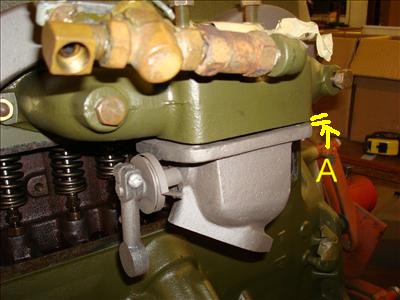 That would be leaks where the two manifolds come together at joint "A".
Are the fording valves in the NON Fording position???
Confirm that the metering rod diaphragm and accelerating valve diaphragm are not torn or otherwise damaged or deteriorated?
Confirm that the diaphragm springs are correctly positioned between the diaphragms and the covers. The illustration in the carb manual is incorrect on one of the springs. The CORRECTED drawing is below.
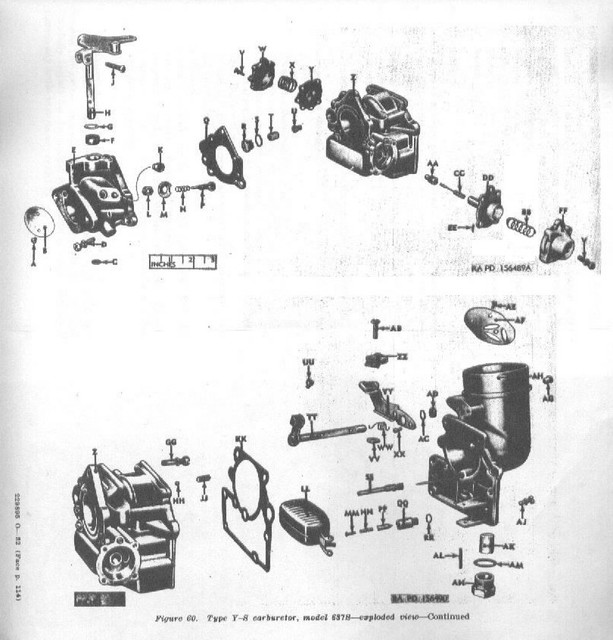
Confirm the bowl and airhorn have both been thoroughly inspected for cracks effecting fuel delivery.
Confirm the vent at the fuel bowl cover is not plugged.
Run the engine, shut it down and wait one hour. Then remove the bowl cover and confirm the bowl is still full of fuel.
Come back and let us know what you find.
That would be leaks where the two manifolds come together at joint "A".Are the fording valves in the NON Fording position???
Confirm that the metering rod diaphragm and accelerating valve diaphragm are not torn or otherwise damaged or deteriorated?
Confirm that the diaphragm springs are correctly positioned between the diaphragms and the covers. The illustration in the carb manual is incorrect on one of the springs. The CORRECTED drawing is below.
Confirm the bowl and airhorn have both been thoroughly inspected for cracks effecting fuel delivery.
Confirm the vent at the fuel bowl cover is not plugged.
Run the engine, shut it down and wait one hour. Then remove the bowl cover and confirm the bowl is still full of fuel.
Come back and let us know what you find.
Wes K
45 MB, 51 M38, 54 M37, 66 M101A1, 60 CJ5, 76 DJ5D, 47Bantam T3-C & 5? M100
Mjeeps photo album: http://www.willysmjeeps.com/v2/modules. ... _album.php
45 MB, 51 M38, 54 M37, 66 M101A1, 60 CJ5, 76 DJ5D, 47Bantam T3-C & 5? M100
Mjeeps photo album: http://www.willysmjeeps.com/v2/modules. ... _album.php
-
wesk
- Site Administrator
- Posts: 16466
- Joined: Sun Apr 03, 2005 6:00 pm
- Location: Wisconsin
- Contact:
Rusty,
I should have better explained what to look for between the intake and exhaust. That gasket will only result in an exhaust leak. Once you have separated the manifolds inspect the mating part of the intake for cracks that may be leaking. These will suck in exhaust gasses and thin the fuel ratio.
The heavier gauge spring goes on the accelerator pump side.
I should have better explained what to look for between the intake and exhaust. That gasket will only result in an exhaust leak. Once you have separated the manifolds inspect the mating part of the intake for cracks that may be leaking. These will suck in exhaust gasses and thin the fuel ratio.
The heavier gauge spring goes on the accelerator pump side.
Wes K
45 MB, 51 M38, 54 M37, 66 M101A1, 60 CJ5, 76 DJ5D, 47Bantam T3-C & 5? M100
Mjeeps photo album: http://www.willysmjeeps.com/v2/modules. ... _album.php
45 MB, 51 M38, 54 M37, 66 M101A1, 60 CJ5, 76 DJ5D, 47Bantam T3-C & 5? M100
Mjeeps photo album: http://www.willysmjeeps.com/v2/modules. ... _album.php
-
Bobber
- Active Member
- Posts: 178
- Joined: Sat Feb 08, 2014 6:00 pm
- Location: Tri Cities, Washington
-
Bobber
- Active Member
- Posts: 178
- Joined: Sat Feb 08, 2014 6:00 pm
- Location: Tri Cities, Washington
OK, I switched the springs around on the carb. Took 150 emery cloth over a file and cleaned off the mating surfaces of intake and exhaust. Checked the intake and exhaust to make sure they were even across the mating surface with a straight edge. No cracks or abnormalities identified. Ran the motor with and without the vacuum pump (plugging off the vacuum of the intake). All surfaces were clean. Took a straight edge across the carb base to make sure it was good, it was. I wish I had another carb to at least eliminate that as a problem.
Thanks
Thanks
-
Bobber
- Active Member
- Posts: 178
- Joined: Sat Feb 08, 2014 6:00 pm
- Location: Tri Cities, Washington
-
wesk
- Site Administrator
- Posts: 16466
- Joined: Sun Apr 03, 2005 6:00 pm
- Location: Wisconsin
- Contact:
Since the military distributor has no vacuum advance you must have a civilian Willys distributor.
Wes K
45 MB, 51 M38, 54 M37, 66 M101A1, 60 CJ5, 76 DJ5D, 47Bantam T3-C & 5? M100
Mjeeps photo album: http://www.willysmjeeps.com/v2/modules. ... _album.php
45 MB, 51 M38, 54 M37, 66 M101A1, 60 CJ5, 76 DJ5D, 47Bantam T3-C & 5? M100
Mjeeps photo album: http://www.willysmjeeps.com/v2/modules. ... _album.php