Page 2 of 3
Posted: Sun Apr 30, 2017 7:05 am
by 4x4M38
Wow that's a dramatic picture. I never cease to learn things here.
Re: Copper Head Gasket
Posted: Sun Apr 30, 2017 8:52 am
by cabinfever
G740 wrote:Midwest Military stocks the copper head gaskets for the L and F head engines.
John
Check your email, JB. I ordered one yesterday.

Posted: Fri May 05, 2017 8:12 am
by cabinfever
UPDATE: I got my cylinder head back from the machine shop.
They dipped it, so it looks almost new....put now I will have to repaint it.
They magnafluxed the head and found no cracks.
The mating surface was quite uneven, however. The shop machined the surface to make it flat again. (Perhaps the uneven surface was the reason for the coolant leak?)
Today, I will be painting the head being very careful not to get any point on the top or bottom of the head. Also, wire brushing the head bolts and chasing the threads in the engine block with a tap. And, prepping the mating surface on the engine block.
The copper gasket has arrived from Midwest Military.
Posted: Fri May 05, 2017 8:19 am
by oilleaker1
When you seal the bolt threads, I've found it helps to put sealant on the block threads and bolt threads. The bolt sometimes gets cleaned off by the block threads and still leaks. John
Posted: Fri May 05, 2017 8:56 am
by cabinfever
oilleaker1 wrote:When you seal the bolt threads, I've found it helps to put sealant on the block threads and bolt threads. The bolt sometimes gets cleaned off by the block threads and still leaks. John
How do you get the sealant into the threads without getting it all over the mating surface of the engine block? Do you use a Q-tip?
Posted: Fri May 05, 2017 9:16 am
by oilleaker1
That would work. A little that gets out won't hurt much since you will be installing and torqueing. The hole in the gasket itself would provide space too.
Posted: Fri May 05, 2017 9:37 am
by wesk
Try to use thread chasers not thread dies & taps when cleaning threads. One is made to clean and the other takes more metal away. Especially head bolt threads and spark plug threads.
Posted: Fri May 05, 2017 4:04 pm
by cabinfever
wesk wrote:Try to use thread chasers not thread dies & taps when cleaning threads. One is made to clean and the other takes more metal away. Especially head bolt threads and spark plug threads.
Wes, it's too bad I didn't see your advice earlier.
The bad news is, I used a regular thread tap. The good news is (I think), I only used my fingers to screw it in. If there was resistance, I backed it out moved on.
Posted: Sat May 06, 2017 5:54 pm
by cabinfever
Had a bit of a setback today. I should have listen to both oilleaker1 and John Bizal. Both suggested that no sealer is needed on the copper gasket.
Well, thought I'd do a little research (I tend to over think things) and found the website of the gasket maker. The manufacturer recommended using copper gasket sealant on both sides of the gasket.
Now I had a decision to make. Follow the manufacturer's recommendation or the advice of two pros? I chose to use the sealant.
I placed the now tacky as heck gasket on the engine block. Then, I slowly lowered the head using my jerry-rigged block and tackle which was hanging from the garage rafter.
I didn't get the head perfectly centered on the engine block. So, I lifted the head to readjust it. The lifting of the head cause the gasket to split into two plies! That's how tacky that sealer was.
So, I learned a lesson. I am ordering another copper gasket. This time it goes on with no sealer.
In hindsight, I suppose I could have run four long wood dowels from the head holes into the block threads to act as guides as I lowered the head.
Posted: Sat May 06, 2017 10:13 pm
by wesk
Hindsight is ___________________!
I prefer to follow the gasket makers instructions. They all put instructions in the box with the gasket. The many manufacturers do not always agree so try to stay with the one that made your gasket. Don't assume that if Jones gasket uses sealer then Smith's gaskets will also! And try to stay with the engine's OEM instructions except where they disagree with the new part manufacturers instructions.
When good folks offer advice that does not agree with the manufacturer's advice I corner them for the "Make/Model/Part Number" to be sure they are talking about the one I have then I make that nasty decision.
I always try to use guide studs during most engine assembly work. Especially where gasket sealers are used!
Posted: Sun May 07, 2017 8:05 am
by cabinfever
Wes, what do you use for your guide studs? Did you cut off the heads of 7/16-14 bolts? Or, maybe cut lengths from a threaded rod?
Also, how many would you use? One in each corner?
FYI, the gasket I got from MM did not have any directions. It was made by Best Gasket Company.
http://www.bestgasket.com/about_our_products.asp
Posted: Sun May 07, 2017 9:16 am
by wesk
Wes, what do you use for your guide studs? Did you cut off the heads of 7/16-14 bolts? Or, maybe cut lengths from a threaded rod?
Also, how many would you use? One in each corner?
I use a special thought process called "KISS" "Keep It Simple Stupid"!
Why cut anything. Just use two old head studs that are long enough so you can remove them. Or go to the hardware store and buy a couple of long enough studs. You are only concerned with the threads on at least one end matching the block's 7/16x14NC threads. 5 to 6" long will do it.
I just use two and find that diagonally works just fine.
FYI, the gasket I got from MM did not have any directions. It was made by Best Gasket Company.
A "Do it yourselfer's" worst enemy is an aftermarket part without instructions! You are damned if you do and damned if you don't follow the OEM's instructions so in the interest of curiosity you research the vendor's web site and choose the vendor's destructions since they would be newer than the OEM's instructions.
On a similar note, the military technical writers always had a tendency to under write the material they had from civilian sources when writing the military versions of the manual. Therefore I always recommend you use the Willys / Kaiser civilian service manual most appropriate to your military model jeep in conjunction with your military manuals.
For the M38 use the civvvy SM-1002 and for the M38A1 use the civvy SM-1046.
Posted: Sun May 07, 2017 9:44 am
by cabinfever
That's interesting.
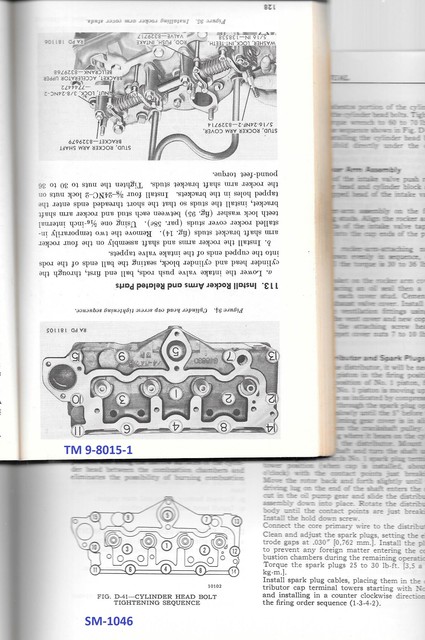
The civvy manual and the military TM have slightly different torquing sequences.
As far as gasket sealer goes, civvy says to use spray sealer on the gasket, TM does not mention a sealer.
I was told that the crimped edge of the copper gasket goes up. The civvy manual says the crimped edge goes down.
Since I don't have any extra bolts or studs around here, I will be going to the hardware store to buy some.
Thanks again, Wes.
Posted: Sun May 07, 2017 5:33 pm
by wesk
Don't read anything into the manual. Just take info from the manual.
For the gasket you must decide which source to use. The civvy manual was printed in 1971. The asbestos center gasket was still in use.
The torque sequence is identical in TM 9-8015-1 and the SM-1046. The civvy manual's illustration is inverted when compared to the TM 9-8015-1. The numbers are in the same holes.
Posted: Sun May 07, 2017 8:52 pm
by cabinfever
Yeah, I was comparing SM-1046 to TM9-8014 (below). I take it either sequence will have the same result.
