Page 1 of 1
Flooding carb
Posted: Mon Apr 25, 2016 5:00 am
by Bobber
The jeep runs great, starts very well. Except about 10% of the time it floods out after its been started and ran. It may be driven for 10 min or an hour, it doesn't matter. I didn't drive it for about a week and it started up on the 2nd to 3rd crank. I drove it about 10 miles and let it set for about an hour, then I get ready to go home and it floods without even trying to catch. So what I do is remove the plugs I put in place of the primer nozzles. Start it up, let it clear up, then I turn it off, replace the plugs and starts right up. I could run to town and turn it off and restart it 6 or 7 times with out a problem. But sooner or later it won't start with out flooding. Then I start the process over and it's fine. New pump, carb, fuel lines, filter,clean tank, new gas. It's intermittent like an electrical thing. New starter switch too. When I start it with out the plugs, it sputters like there is too much fuel till it starts to take off due to lots of air. So I think fuel is being sucked in some how. Or the float is catching and allowing too much fuel in. I even try to floor the gas peddle like manual says to allow max air flow to the carb. 90% of the time it's a dream to drive. BTW, all original except starter and alt. Your thoughts?
Posted: Mon Apr 25, 2016 8:14 am
by wesk
I'll assume you have positive evidence of flooding with heavy fuel smell and raw gas emitting from carb.
The first & obvious checks will be to confirm choke control places the choke where you want it. Then check all fittings and nuts/bolt for tightness.
Then start with the
new pump's output pressure. Get a gauge in line and make sure it is within limits. [ 4 to 5 1/4 PSI at 1800 RPM ]
While making running checks verify manifold vacuum is within limits. [ 10" at 200 RPM and 12" at 1500 RPM ]
Then remove each vacuum diaphragm cover and check condition of the accelerator pump & metering rod diaphragms [ Y & DD ]. And make sure springs [ X & BB ] are positioned correctly.
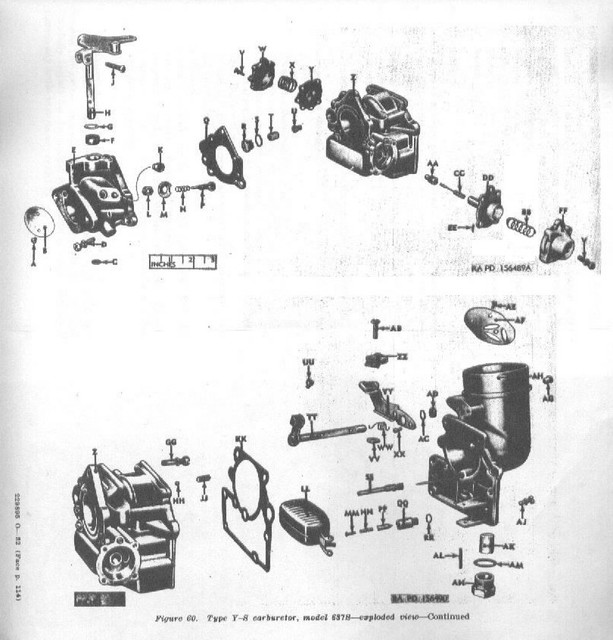
Then remove the air horn and check float height and proper float valve operation. [ 1/4" ]
Then inspect inside of bowl for cracks, particularly next to the throttle bore.
Needless to say you should be in the books on this as well:
TM 9-8012 for most specs and adjustments. Also has a very good troubleshooting guide for the problem you describe on pages 79-81.
TM 9-1828A Fuel Pumps
TM 9-1826A Carter Carbs making sure you are using my corrected Fig 60.
Since these manuals are available free in PDF here on our downloads page it is impossible for any intelligent person not to be using them.
Posted: Tue Apr 26, 2016 4:43 am
by Bobber
You are correct. I'll be consulting them soon.
Thank you