Page 1 of 1
Block letter markings near cylinders
Posted: Fri Feb 24, 2017 9:52 am
by strathdaigeil
I'm having this engine rebuild and am curious as to the meanings of the letters by each cylinder.
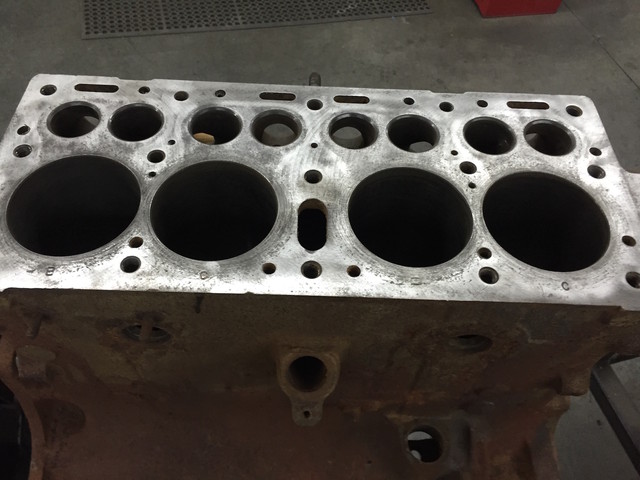
any ideas?
Posted: Fri Feb 24, 2017 10:25 am
by wesk
I moved your post here to the Technical board from the Jeep Projects board.
Corrected my erroneous reply. see replies below.
Posted: Fri Feb 24, 2017 11:27 am
by strathdaigeil
I had this reply from the facebook page:
"There are tiny variations in the factory boring of cylinders on the order of .001"-.002" rather then try to match the cylinder to a specific size of piston. Pistons were made in 4-5 different sizes that varied by something like .0005". So after a block was honed it was measured and that measurement represented by a Letter A through G (some discussion on the letters E-G being used on industrial engines) so the assembly person would just grab a Piston that matched the cylinder measurement and go. Much faster then the other way around."
Posted: Fri Feb 24, 2017 11:40 am
by mbullism
strathdaigeil wrote:I had this reply from the facebook page:
"There are tiny variations in the factory boring of cylinders on the order of .001"-.002" rather then try to match the cylinder to a specific size of piston. Pistons were made in 4-5 different sizes that varied by something like .0005". So after a block was honed it was measured and that measurement represented by a Letter A through G (some discussion on the letters E-G being used on industrial engines) so the assembly person would just grab a Piston that matched the cylinder measurement and go. Much faster then the other way around."
This is found in documentation for L134's for 2A's, etc...I think generally A-E. It is factory, for piston selection. I have RMC105103 and it has E's and F's, for which I could not find direct literature. I did find the RMC engine in a pe-95K genset, so E-G for industrial would fit...
.02
Posted: Fri Feb 24, 2017 12:11 pm
by wesk
My Bad. Yes for factory selection of pistons but not a very wide spread in diameters since engine balancing was at stake I am sure they were very minor variations since the pistons still had to stay within balancing limits. Most likely these were standard pistons which had been categorized by letters to represent small variations in diameter. They then would be stocked on the engine assembly line in A, B, C & Etc trays or bins. They could not have been standard oversizes which started at 0.020 thru 0.040 with 0.060 being available aftermarket.
Don't confuse the letters being discussed with the suffix on factory engine serials A or B or AB in which B represents an actual 0.010 oversize bore and piston set.
Posted: Fri Feb 24, 2017 1:35 pm
by 4x4M38
And I guess good gravy you better get those pistons back in the right bores?
Posted: Wed Mar 15, 2017 3:20 pm
by mbullism
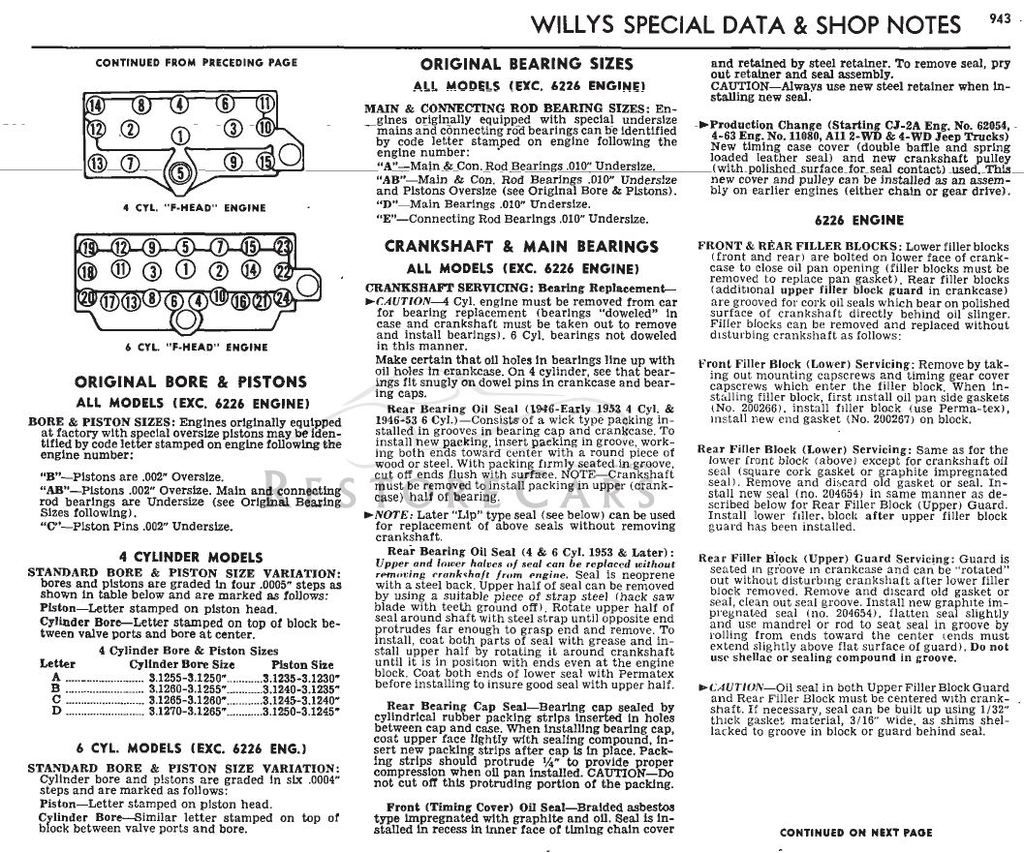
"re-found" this in my travels...just posting for completeness and future reference-
From the "1946-1957 National Service Data", lower left of page 943
.
Posted: Wed Mar 15, 2017 7:50 pm
by 4x4M38
That's a nice find!
Posted: Wed Mar 15, 2017 8:01 pm
by RonD2
Maybe just me (I'm a rookie )

, but isn't the block photo at the top of the post an L-head motor?
The "Special Data and Shop Notes" sheet seems to call out F-head motors. Preceeding pages maybe mention the L-head?
Are the specs and markings the same for both type motors?
Hold on Wes! I should look it up myself in the L-134 manual

Posted: Wed Mar 15, 2017 9:26 pm
by wesk
but isn't the block photo at the top of the post an L-head motor?
No, it's F134 F head. Note the #5 headbolt is under the carb base!
The "Special Data and Shop Notes" sheet seems to call out F-head motors. Preceeding pages maybe mention the L-head?
Actually for the discussion topic which is the data in the lower left corner the reference is to all 4 cylinder engines both L & F heads.
Are the specs and markings the same for both type motors?
Yes
Hold on Wes! I should look it up myself in the L-134 manual Very HappyYou would have to look it up in both the L134 and the F134 manuals if you want to know if the data/specs are the same for both.
Posted: Wed Mar 15, 2017 11:16 pm
by wesk
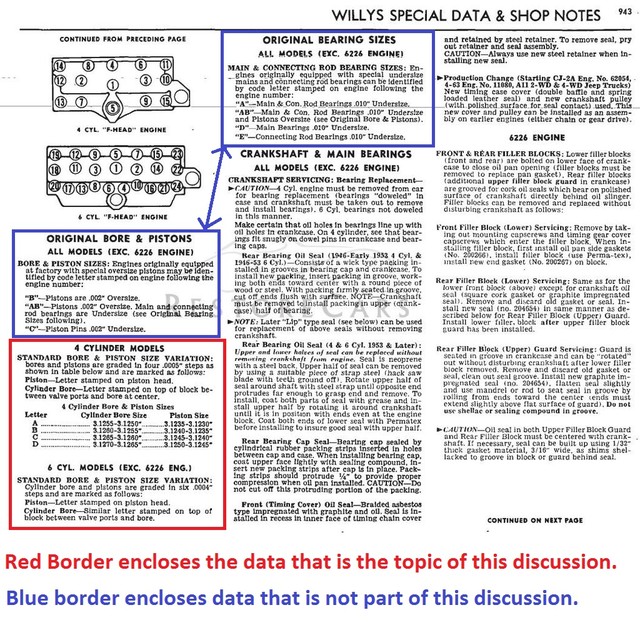
The area encircled in red is the part this discussion is about. The meaning of the letters stamped next to each cylinder bore on the top of the block. These are extremely small deviations to standard diameter pistons that the factory addresses with the use of standard size pistons that have been accurately measured and then categorized as an A, B, C or D piston where the largest variation is .0005. That 5/10 thousands of an inch. True oversize pistons come in much larger denominations starting at .002 which is 2/1000th of an inc.
The areas encircled in blue explain the meanings of the letters used to suffix the engine serial numbers when real in service oversizes and undersizes are used on a factory engine at the factory. These are the oversizes & undersizes listed in the Willys parts manuals that start at .002 and up..
Posted: Thu Mar 16, 2017 8:06 am
by mbullism
I re-found this in my own library...the full manual is online, "somewhere" I can't recall, and cannot be downloaded(?) (Or I likely would have, lol). It's over a thousand pages, I only pdf'd those to do with Willys/Kaiser/Frazer/Henry J, still it's 49 pages of Willys alone.
The info is specific where it has to be for L vs. F, and that listed as "4 cyl." typically applies to both. The two engine diagrams upper left on p943 are actually #'s 4&5 of 5 for head bolt tightening sequences continued from p942, fwiw.
Posted: Thu Mar 16, 2017 9:03 am
by wesk
I only reposted your page to help clarify for the group exactly what data was to be used for which reason. The web page where that manual is listed is a real PITA to use.
http://restorecarsclassifieds.com/wiki/ ... .php?n=254
I had this reply from the facebook page:
"There are tiny variations in the factory boring of cylinders on the order of .001"-.002" rather then try to match the cylinder to a specific size of piston. Pistons were made in 4-5 different sizes that varied by something like .0005". So after a block was honed it was measured and that measurement represented by a Letter A through G (some discussion on the letters E-G being used on industrial engines) so the assembly person would just grab a Piston that matched the cylinder measurement and go.
This quote is also mis-leading the group. The factory did not produce 4 or 5 standard pistons sized .0005 apart. There was only one standard piston PN 801476 and oversize pistons were made in much larger increments IE .010, .020, .030 and .040 at the factory. You could also find .060 and .080 aftermarket.
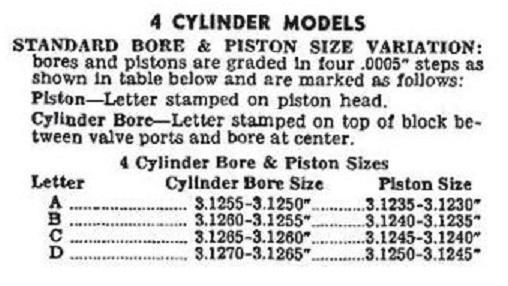
What this means is that when the factory stocked the assembly line with standard PN 801476 pistons they dimension checked (miced) each of them and divided them into 4 classes with each class covering a .0005 spread. So as an example there would be four boxes of standard PN 801476 pistons on the assembly line. The "A" box would contain PN 801476 standard pistons that miced at 3.1235 to 3.1230 diameter range. The "B" box would contain PN 801476 standard pistons that miced in the 3.1240 to 3.1235 range and so on. All four boxes had PN 801476 standard pistons in them that were originally cast or forged and machined to a spec that permitted them to be any where from 3.1230 to 3.1250 in diameter and still be within tolerance for a PN 801476 standard piston. Then to insure the best possible matching fit on the line they then segregated those standard pistons into 4 size groups on the assembly line.
___________________________________________________________
All the above has nothing to do with the letter suffixes to the engine's serial number. Engine serials with the letter suffix B actually had a special .002 oversize piston installed. This happened occasionally when brand new production blocks with minor bore surface damage required a clean up cut that took the bore just a wee bit past the fit that could be obtained with the largest standard piston available.
