Design intent behind M38A1 battery box
Posted: Wed Jun 03, 2020 7:18 pm
I've been discussing the battery box for M38A1 with some friends and wondering if anyone has insight into the design and intent - especially some changes that came between MB where it was simply a tray in the engine bay to M38 where (if I'm understanding correctly) it was a pair of boxes one in cowl one in the engine bay, to the M38A1 where it's a box in the cowl with two batteries.
I'm wondering why a box rather than a bracket to support the tray. Is the concern battery acid spilling on the passenger or something else? If so, why does it look like there are a lot of holes in the bottom of the box? In this pic from Wes' gallery looking down the box toward the drain setup there looks like quite a gap between the bottom and the side:
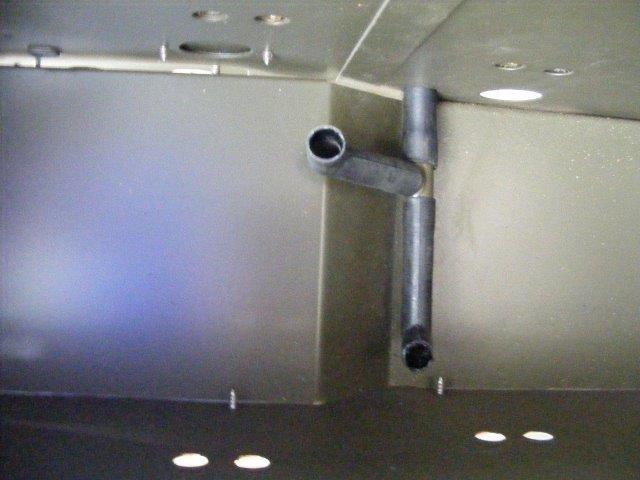
Additionally, there look to be several large drain holes in the base of the box lower than the tray drains.
What are the drains connecting the trays and then routing through the firewall intending to collect and drain exactly? If it's battery acid, then it seems like the tray really doesn't make a very deep dam to collect this - that the slightest bit of angle of the vehicle off of level would let the acid spill over and then find an opening to get into the passenger footwell.
It seems that the presence of these drains (even aside from the various incidental holes and gaps) mean that in deep water fording the battery box itself will get flooded. A friend of mine wondered if the weather seal around the cover would present enough of an air pocket that the top of the batteries wouldn't get flooded, but it seems to me that for that to work, the top edge of the box would need an airtight seal against the underside of the cowl, which it doesn't seem like it has. It also seems that it is desirable for the hydrogen from the battery vents to have a relatively free path to open atmosphere (since I don't think the top of battery box is airtight, I don't think this is a problem, but if it's intended to be airtight, then that would seem to be an issue).
None of this is to say that the design is wrong - I'm just trying to make sense of it.
I'm wondering why a box rather than a bracket to support the tray. Is the concern battery acid spilling on the passenger or something else? If so, why does it look like there are a lot of holes in the bottom of the box? In this pic from Wes' gallery looking down the box toward the drain setup there looks like quite a gap between the bottom and the side:
Additionally, there look to be several large drain holes in the base of the box lower than the tray drains.
What are the drains connecting the trays and then routing through the firewall intending to collect and drain exactly? If it's battery acid, then it seems like the tray really doesn't make a very deep dam to collect this - that the slightest bit of angle of the vehicle off of level would let the acid spill over and then find an opening to get into the passenger footwell.
It seems that the presence of these drains (even aside from the various incidental holes and gaps) mean that in deep water fording the battery box itself will get flooded. A friend of mine wondered if the weather seal around the cover would present enough of an air pocket that the top of the batteries wouldn't get flooded, but it seems to me that for that to work, the top edge of the box would need an airtight seal against the underside of the cowl, which it doesn't seem like it has. It also seems that it is desirable for the hydrogen from the battery vents to have a relatively free path to open atmosphere (since I don't think the top of battery box is airtight, I don't think this is a problem, but if it's intended to be airtight, then that would seem to be an issue).
None of this is to say that the design is wrong - I'm just trying to make sense of it.