Page 1 of 1
Time to lick this brake issue once and for all....
Posted: Fri Nov 27, 2009 7:07 pm
by linx310
Got my jeep to my new garage, but I had to stop twice to bleed the brakes because the pedal got extremely hard and I could barely stop.
When I would crack open the left and right front bleeders and drain some fluid out it the brakes pedal would go back to normal for a bit. Also fluid would squirt out rather then just drain and my brake light would come on even when i wasn't touching the brakes.
It has to be the old rubber hoses and lines. I replaced every thing else.
I installed a new master cylinder and new wheel cylinders but the problem continues. I even tried backing off a bit on the adjustment screw for the brake pedal shaft to make sure the piston is getting enough free play.
Posted: Sat Nov 28, 2009 2:17 am
by wesk
The hoses can trap fluid at the brake but not operate the brake light. If the brake light is coming on then the master cylinder is actuating znd is not relieving pressure internally.
Pump the brakes up and when your brake light stays on quickly loosen the brake light switch and let fluid escape.
Posted: Sat Nov 28, 2009 10:33 am
by cody10414
Did the master cylinder function ok when you bleed it prior to installation?
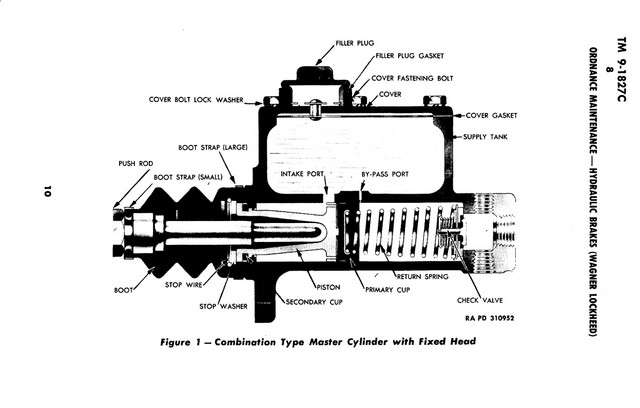
Check out this example master cylinder image to aid in your trouble- shooting.
When the brake plunger is pushed passed the bypass port the brake fluid pressure is increased and flows past the check valve out to the brake cylinders. On release, as the plunger (piston) returns to the position shown, the check valve unseats and allows the fluid at pressure to return to the master cylinder, with excess pressure/fluid returning to the reservoir via the bypass port.
Dont fill the reservoir to the brim (leave about 1/2") and make sure your fill vent is not obstructed. The exhaust pipe heat can pressurize a sealed off master cylinder considerably.
Posted: Sat Nov 28, 2009 4:09 pm
by oilleaker1
The ram that the petal pushes into the master cylinder---MUST come all the way to the rear. If the brakes get heated up and the fluid expands, it returns back to the master. If you don't have the correct petal freeplay, the fluid acts against the adjustment and literally applies the brakes. Check for the correct petal freeplay! John
Brakes
Posted: Sun Nov 29, 2009 7:56 pm
by G740
You did not indicate if you replaced the hoses at the same time you did the cylinders. A very common mistake by new owners is to only replace the cylinders because the think the hoses look fine. In fact, the hoses are the most problematic item in the system when first done. The inside of the hose will swell up from a reaction to the new fluid and act as a one way check valve. I see this all the time. Replace the hoses, and you problem should go away.
John
Posted: Sun Nov 29, 2009 9:08 pm
by linx310
You did not indicate if you replaced the hoses at the same time you did the cylinders. A very common mistake by new owners is to only replace the cylinders because the think the hoses look fine. In fact, the hoses are the most problematic item in the system when first done. The inside of the hose will swell up from a reaction to the new fluid and act as a one way check valve. I see this all the time. Replace the hoses, and you problem should go away.
John
I have a complete set on the way. Gonna also look at the pedal adjustment again, maybe i screwed it up.
Posted: Mon Nov 30, 2009 9:40 am
by cmpman
In service it was usually a lack of pedal freeplay that caused the brakes to lock on, including the brake light, as you describe. If you push the pedal with a couple fingers you should feel the freeplay before the rod comes into contact with the m-cyl piston.
I never saw an internal hose failure when I was in the military, but then again the trucks were less than 20 years old. Now that some of the 50s vintage jeeps are nearing 50 years of age, problems will crop up that we rarely saw in service.
Posted: Mon Nov 30, 2009 11:09 am
by wesk
I have seen many internal hose failures over the years and when they fail in a manner that keeps pressure trapped at a wheel it does not leave any pressure at the master cylinder therefore it does not leave the brake light illuminated.
So, yes the failure of an old hose can keep pressure applied on a brake downstream from it.
Can that hose failure keep the brake light on? No.
In your case the issue will be either the master cylinder or it's free play adjustment as cmpman points out.
Posted: Fri Dec 04, 2009 1:01 am
by SteveJ
Ive seen at least two rebuilt master cylinders with the wrong length piston in them. everything fits fine andthe brakes work when you step on them but after a few brake applications the pedal gets hard and they stay on. The longer piston does not return far enough to allow the fluid to move back into the reservoir

Posted: Mon Apr 12, 2010 12:26 pm
by M38UND
My brake pedal moves wiht the clutch. I have loosened the clamps on both the pedals, but they still move together, any ideas?
Posted: Mon Apr 12, 2010 1:04 pm
by oilleaker1
If your brake and clutch move together, the brake lever is stuck or frozen to the shaft the clutch lever rotates under the floor. The brake lever is supposed to be free to turn on that shaft. The clutch lever is keyed to the shaft and turns the whole thing. The brake lever should have a grease zirc to lube it where it rotates on the shaft. John