Page 1 of 2
Priming the oil pump
Posted: Tue Oct 25, 2011 11:25 am
by RICKG
I've read that priming the oil pump prior to starting a
rebuilt engine is important. I'm finding no info in the TM's
or on the boards on how to do this.. Any help appreciated.
Posted: Tue Oct 25, 2011 1:00 pm
by wesk
You should have immersed the entire oil pump in engine oil and allowed it time to fill up before you installed it. This is usually adequate if you start it as soon as you install the pump. Most professional shops have a small mechanical or electric pump in the shop with a reservoir for engine oil and a hose that can be adapted to one of the main oil gallery threaded pipe plugs.
Posted: Tue Oct 25, 2011 1:21 pm
by RICKG
The engine was built by a professional engine shop. Their
"Grizzled Old Guy" did the actual rebuild. I picked up the
engine at their shop dry of oil. I added the oil after putting
it back in the frame. This was over a year ago. I'll call
and see what he has to say about it. Thx, Rick
Posted: Tue Oct 25, 2011 1:31 pm
by wesk
My advice when in your shoes is an ounce of pre-oil is worth $100's of dollars of rework. No matter what the Great Grizzled One says I would pre-oil.
If I had just installed the oil soaked pump myself and I did not have a pre-oiler around I would crank the engine with the ignition off until the oil pressure gauge showed a wee bit of needle rise.
Posted: Tue Oct 25, 2011 1:55 pm
by RICKG
Griz tells me that they "lube" the pump during re-assy.
Pre-oil i will. If i remove the valve spring cover plate
i should be able to see oil flow while cranking the engine
with switch off right?? Meanwhile I'll look for a pre-oiler
at one of the local AG shops.
Priming
Posted: Tue Oct 25, 2011 1:56 pm
by rdsar2k
I didn't do a lot of research on the Motor Pool mechanic way of doing buiness when I hit this point on my overhaul so take this with a grain of salt. I disconnected the oil line on the rear of the engine that supplies the rocker shaft in the head. I then connected a barbed fitting with pipe threads to the oil resevour (bottom fitting side of the rear oil line). Then I disconnected the oil supply line to the oil filter at the filter. I bought a cheap oil pump from harbor frieght (or any auto part store) and pumped oil into the resivoir until it came out the line to the oil filter. To be sure, I loosened the relief valve on the pump to see if oil was there and it was.
Click on the links to see the parts I'm talking about. Instant oil pressure on start up. I did have a pressure sender issue for the gage but that was/is a separate issue.
http://www.amazon.com/Anderson-Metals-5 ... B000BQWBIM
http://www.harborfreight.com/sta-lube-g ... 40714.html
Posted: Tue Oct 25, 2011 10:20 pm
by wesk
All of that will work except for Rick's M38 the oil line to the rocker doesn't exist. It's still easier to just remove the extra 1/8" pipe plug on the left side of the block between the oil pump and the oil pressure gauge sender port and plug in the pump there. He can just pop the lid on the oil filter and watch. A periodic check of the dipstick for oil level is a must as well unless you left the pan empty and the drain plug open.
Posted: Wed Oct 26, 2011 7:36 am
by RICKG
This is all great info. I'll drain +- 2 qt or so of my break-in
oil from the pan then pump it in thru the pipe plug as Wes
noted. with the mil jr oil filter cap off ill see oil flow. Thx guys..
Posted: Wed Oct 26, 2011 12:31 pm
by STXM38A1
Very interesting topic. My engine work may be a light-year away, but I'd like to make sure I understand how to prime the oil pump on a F134.
So assuming the engine is assembled dry (of oil) or next-to-dry, where is the best place to hook up the external, manual pump in order to prime the engine's oil pump & lube system? I'm attaching Wes' picture of the left side of a F134 for reference. (Maybe some quick photo editing to highlight the hook-up point?)
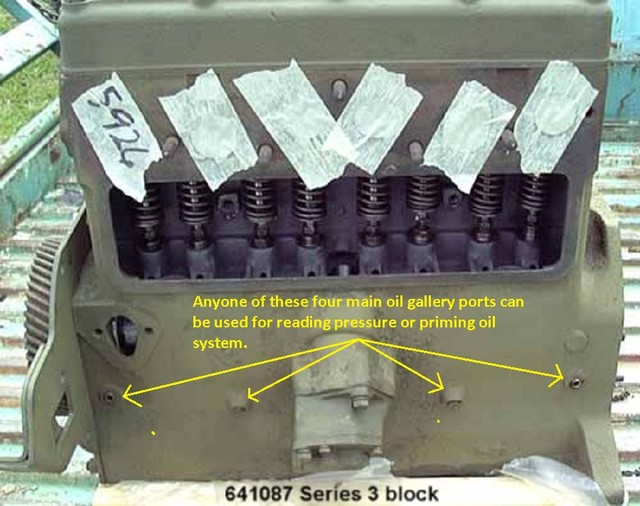
Then, as I understand from the posts, watch in the top of the oil filter (top removed) to comfirm when oil is being pushed all the way to the filter; and be sure to adjust the oil to the proper level (dipstick) before trying to crank and start.
Thanks,
Oil Tap
Posted: Wed Oct 26, 2011 1:14 pm
by rdsar2k
You could use either of the taps at the rear of the engine. Where it says "connect oil pressure gage here" may be a better place then it would send oil up to the rocker shaft. If you left the valve cover off you could see it when it reached the rocker shaft. May have to put your finger over the end of the line going to the filter (if you are using the hand pump) in order to build up enough pressure to reach the rocker shaft. If your intent is to prime the pump and fill the reservoir then either will work.
Posted: Wed Oct 26, 2011 1:28 pm
by wesk
As I said above the plug between the oil pump and the oil pressure gauge tap is the best plug to use. In the photo above that would be the plug with the carb linkage spring attached. Do not fart with the back two plugs. Leaving them connected and unmolested results in oil to your gauge and oil to the rockers on the F134 when you start pre-oiling. On the M38 fooling with that gauge port is even more rediculous since it has a 90 deg elbow and the sender mounted directly to it. There are two more main gallery plugs forward of the oil pump. One is hidden a bit by the exhaust stack and the other is buried behind the fuel pump and has the in line for the oil filter connected to it.
Pre-oiling is effective when all the running clearances are within tolerance. Too tight clearances will result in only partial pre-oiling.
Oil pumps are always soaked in oil before installation. This is one of the most elementary of procedures in any overhaul. Not oiling the pump before install is not excusable under any circumstance.
Oil Tap
Posted: Wed Oct 26, 2011 2:26 pm
by rdsar2k
Wow. Wasn't infering that this is the proper method for priming or as an alternate to soaking oil pump. "More Rediculous " made my face flush in shame. I don't like starting a dry engine even if the pump is soaked and the engine was assembled with the finest assembly lube known to man. I simply state that a person can fill his oil supply system with simple tools and parts prior to starting with this method. The principle is the same regardless of the plug pulled on the gallery to fill it with. Bottom line is pull one of the plugs on the gallery and pump in oil is an option to consider. That all I was trying to say.
Posted: Wed Oct 26, 2011 7:27 pm
by wesk
Try not to be so thin skinned. The comment on not oiling a pump was not aimed at you and I always encourage trainees, newbies or more experienced folks not familiar with the type equipment to keep it simple. By that again I am not referring to you, I mean why disassemble a set of tubing when 4 inches away is a simple 1/8" P plug you can unscrew and get to work.
The simple understanding of hydraulic principals will clue one in that no matter which port you use the pressure across the board will be equal. The flow across the board may not end up equal as I posted above if certain clearances are too tight.
I will always answer any post that puts forward the more complicated, or more difficult method of doing any task with the easier, or less complicated or safer way.
Posted: Thu Oct 27, 2011 5:32 am
by artificer
One usually asembles a rebuilt/interfered with engine with assembly lube @ the least liberal oiling.
Oil pump is recommended to be packed with vaseline on assembly.
Even if the above has been neglected....
Just a few flicks of the starter with the ignition off, spark plugs out will get oil on the move & when the oil gauge starts to pulse, you are ready to put the spark plugs in, turn on the ignition a start her right up.
No biggie @ all.
Posted: Thu Oct 27, 2011 9:51 am
by wesk
Hello John,
I think that is what I said above:
If I had just installed the oil soaked pump myself and I did not have a pre-oiler around I would crank the engine with the ignition off until the oil pressure gauge showed a wee bit of needle rise.
_________________
There are still folks that want to know how to mechanically pre-oil with external equipment and thus this thread.