Page 1 of 1
U joints
Posted: Tue Feb 14, 2012 12:05 am
by Deadguy
I want to replace my U-joints. I have no idea how long the old ones have been there, and I lost a driveshaft on one of my previous jeeps do to a ujoint coming apart (it did have a lift tho, which probably exacerbated the problem).
They range in price from $10 from Rapco, to close to $80 from Morris 4x4 (although those are probably super heavy duty ones for lifted vehicles). Any opinions on what I should get?
Posted: Tue Feb 14, 2012 6:19 am
by danrothe2001
Spicer part number 5-153X. Don't buy into the super duty non greasable ones. Install them so that the grease zerk is in compression while driving and they will be just as strong. We sell them where I work for $15.00 each. Unless you are concerened about show points and need NOS joints.
Dan
Posted: Tue Feb 14, 2012 8:31 am
by donthedickens
danrothe2001 wrote:Spicer part number 5-153X. Don't buy into the super duty non greasable ones. Install them so that the grease zerk is in compression while driving and they will be just as strong. We sell them where I work for $15.00 each. Unless you are concerened about show points and need NOS joints.
Dan
================
Dan,
Please explain the " Install them so that the grease zerk is in compression while driving".
That sounds like something I need to know.
Thanks..
Posted: Tue Feb 14, 2012 10:53 am
by danrothe2001
Imagine the driveshaft in the vehichle and twist it. The twisting action should close the hole for the grease zerk, not open it.
Dan
Posted: Tue Feb 14, 2012 12:13 pm
by donthedickens
danrothe2001 wrote:Imagine the driveshaft in the vehichle and twist it. The twisting action should close the hole for the grease zerk, not open it.
Dan
===========
I can't wrap my brain around that yet,, but I WILL get one in my hand and look at it real hard.
Thank you for a pointing out the weak spot in a greasable u-joint.
Posted: Tue Feb 14, 2012 12:44 pm
by Bretto
Makes sense to me. Detemine which way the driveshaft rotates when the vehicle drives forward. Put the zirk hole ahead of the bearing caps of this motion. Also make sure they are pointed the right way to make it easy to get a grease gun in there as sometimes the zirks are angled.
-Brett
Posted: Tue Feb 14, 2012 2:06 pm
by artificer
I think someone needs to post a picture or two as the previous words do not explain adequately.
If I did not know how, the words just don't cut the mustard.
Posted: Tue Feb 14, 2012 3:11 pm
by kenperkins
Posted: Tue Feb 14, 2012 3:19 pm
by Bretto
Ya, pics are worth a thousand words they say. If no one chimes in with a pic on the hole placement, I will do it later. I dont have time right now. Ken's link shows how to properly point them for greasing but doesnt point out the placement for strength.
Posted: Tue Feb 14, 2012 3:45 pm
by artificer
A couple of points about the link....it should not be necessary to use hammers on the cups when pulling apart & never when assembling.
All you need is a good vyce & a set of sockets to press the assy's apart.
Remove zerks before p[ulling appart & note where the grease nipples are if theuy were working properly....compare with new joints to ensure they are made the same & in correct alignment....often they are not!
Just ensure after assy & the circlips are in place that you place the shaft eyes over the vyce jaws & that is when you use the hammer, to ensure all bearing cups are out against the circlips & thus centralised.
Lastly fit the grease nipples & give a squirt then wipoe away excess grease.
Posted: Tue Feb 14, 2012 5:57 pm
by Bretto
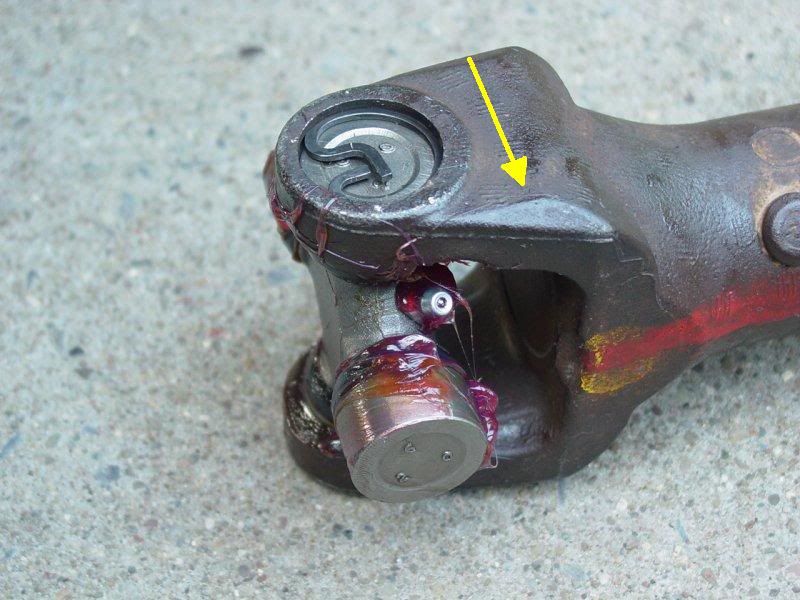
Say this is the axle end. If the rotation to drive the drive the axle forward is the same as the yellow arrow, then this will theoretically close up the zirk instead of opening it up. This is all relative to the power or receiving end. The other end of this shaft would have the zirk on the other side since it would be receiving power in.
Posted: Tue Feb 14, 2012 7:38 pm
by donthedickens
Bretto wrote:Say this is the axle end. If the rotation to drive the drive the axle forward is the same as the yellow arrow, then this will theoretically close up the zirk instead of opening it up. This is all relative to the power or receiving end. The other end of this shaft would have the zirk on the other side since it would be receiving power in.
==================
Bret,
That picture and write up did the trick. I can now see the stress points and the problems that can exist.
MANY THANKS to all who helped me.