Assuming the front timing cover is stock and it has the stock timing pointer just review my photo album.
http://www.willysmjeeps.com/v2/modules. ... _album.php
On the second page you will see an "Ignition Systems" sub-album:
http://www.willysmjeeps.com/v2/modules. ... _album.php
If the engine is stock this is what you should have:
If your front cover is not stock you could have one of these:
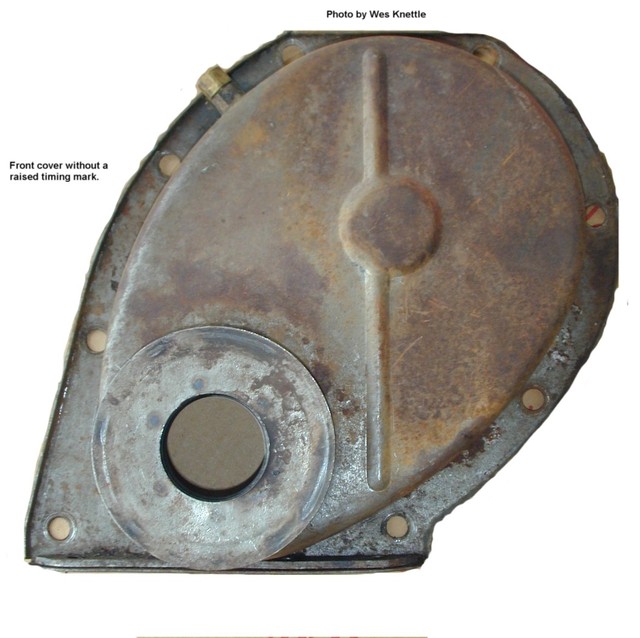
Very early L134 cover with no marks
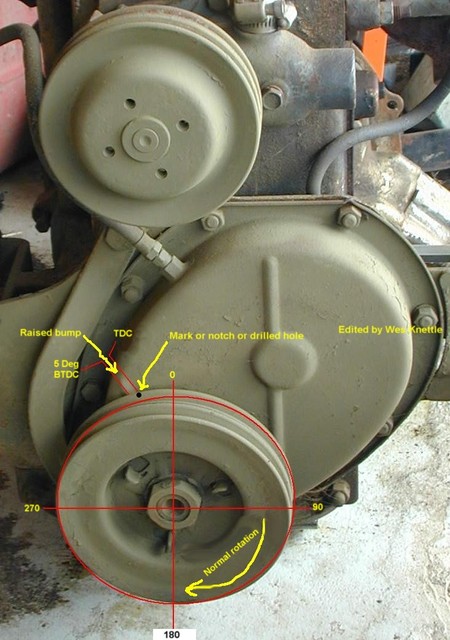
Early L134 raised bump and pulley notch arrangement.
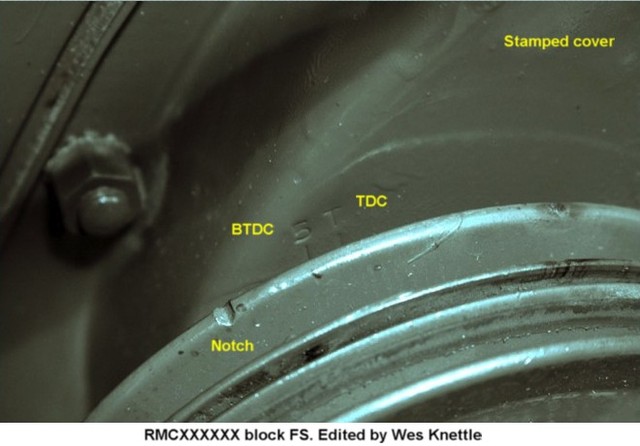
Field stamped cover and pulley notch.
Or worse case you could have a mix and match and will need to establish a TDC to confirm the accuarcy of your existing marks.
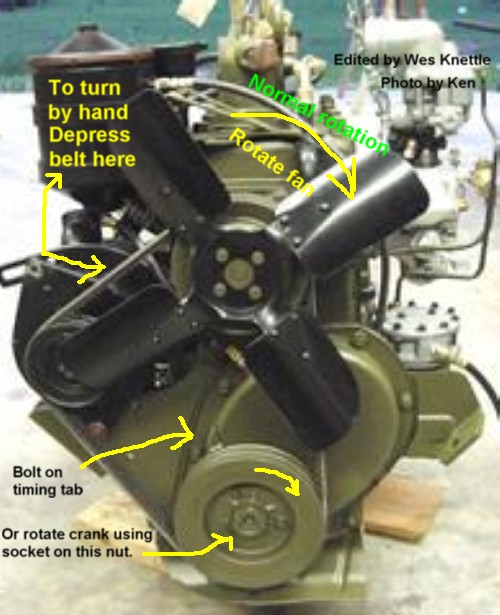
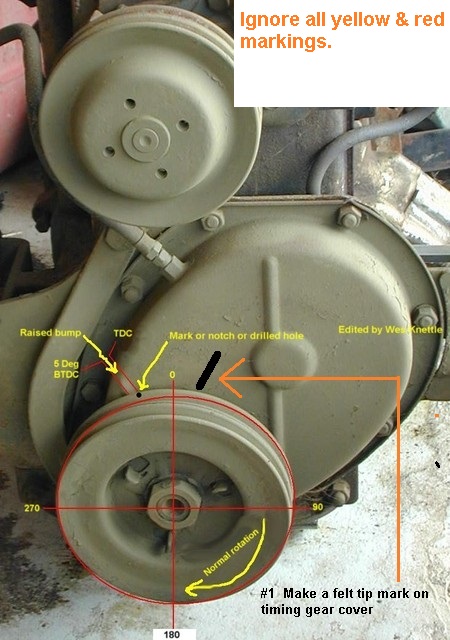
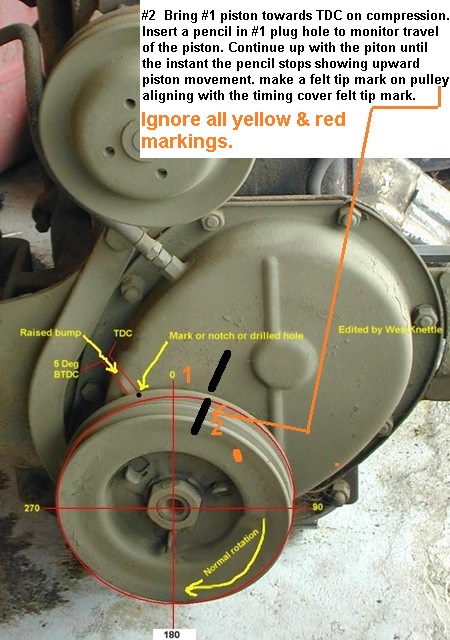
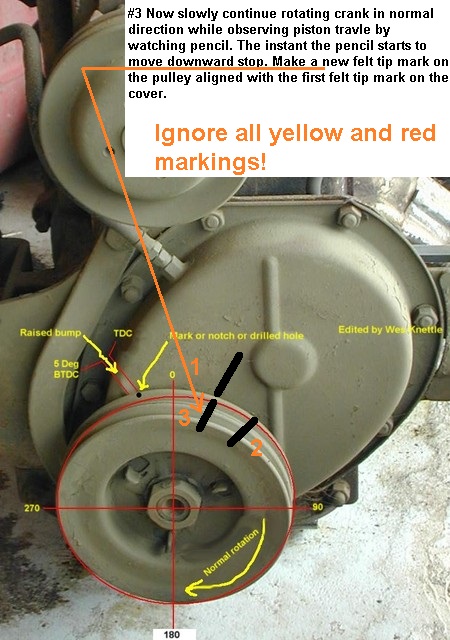
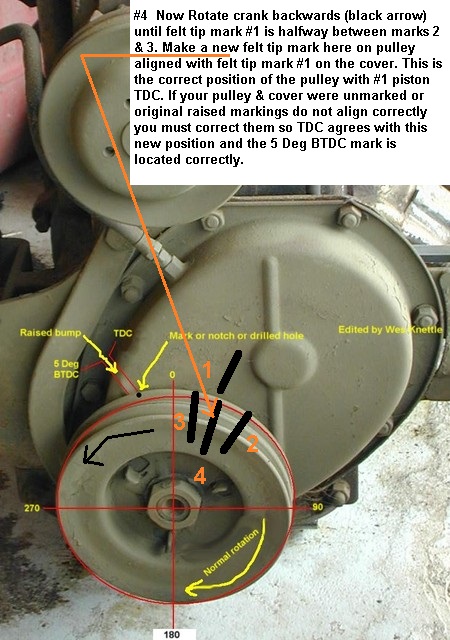
To do this you must get #1 piston TDC on it's compression stroke. Make a felt tip mark on the timing gear cover straight up above the center of the crank pulley. With all four spark plugs removed, You have a friend slowly turn the crank in it's normal rotation (see illustration above ) while you hold your thumb over the #1 spark plug hole. When you feel air pressure building up stop. Insert a pencil or other thin object in the plug hole at a down angle and very slowly continue moving the piston up until the pencil touches the top of the piston. Now continue even slower observing the pencil lower point move up. The instant the pencil stops moving up make a mark on your pulley that aligns with the felt tip mark on the timing gear cover. Now maintaining down angle pressure on your pencil continue rotating the crank in the same direction and stop the instant the pencil starts to move down. Make a felt tip mark on your pulley that aligns with the felt tip mark on the timing gear cover. What you have done is marked the dead spot in the cranks rotation where there is no movement of the piston. This will last several degrees. Now if you make a fourth felt tip mark on your pulley half way between the two marks you just made (that is half of the shorter distance between the marks) and then move the crank pulley back so that fourth mark aligns with the first mark you made on the timing cover you are now at top dead center (TDC). Now how close are your ignition timing marks to being correct?
Illustrations below explain this procedure:
This pencil idea is based on what we mechanics call a "Wigler" which is a tool designed to ride under some mild tension on the top of the piston while it's visible portion gives the mechanic a clue to the direction and rate of piston travel when trying to ascertain TDC. The straight device will work on overhead valve engines including the F134 but you must use a special bent/formed wigler to do this with an l head (flat head) L134 engine.
