Page 1 of 1
Grill Placard
Posted: Mon Oct 06, 2014 6:38 pm
by Mjfire1949
Can anyone tell me what the yellow circular placard mounted on the grill of a military jeep represents? The ones I have seen usually have two numbers separated by a forward slash.

Grill placard
Posted: Mon Oct 06, 2014 7:14 pm
by jeeptj1
I think they are called a bridge plate. Used to determine weight and something else? Not normally used on jeeps is my understanding. I'm sure the rest of the guys have more info. John jr
Posted: Mon Oct 06, 2014 7:16 pm
by wesk
I think you are referring to a Bridge Plate. Not used much on jeeps and the only period photos I have seen of them on a jeep are WWII.

or

or
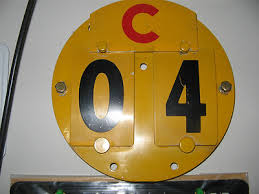
Posted: Mon Oct 06, 2014 8:50 pm
by Kendall
In the two number system, one number represents the vehicle's weight and the second number represents the vehicle's weight plus any equipment it is towing (artillery, trailer, etc).
Kendall
Posted: Mon Oct 06, 2014 10:20 pm
by wesk
In TB 746-93-1 Color & Marking Of MV October 1964:
The sign on the primary vehicle represents that vehicle only. There are two digit positions because class codes are in single digit for 5T & under vehicles and two digits for heavier vehicles. The locking plate at the top of the display has a Red C on one side. If the C is not showing then the vehicle is not towing a trailer and the class number represents only that vehicle. If the Red C is showing that denotes a vehicle in combination with a trailed load and the plate code represents the combined vehicles class. These class codes are found in TB 746-93-1 Appendix 1 table C.
Again only 3/4T and heavier vehicles are required to use the bridge plate and the class codes start at 3/4T. So if you do decide to use a bridge plate on your 1/4T jeep then the proper class code to show is OO.
Posted: Tue Oct 07, 2014 8:07 am
by skyjeep50
From the information I have read the bridge plate was used during WWII so MP's could estimate the weight of all vehicles that would be crossing a bridge at any one time. Bridges were often weak, damaged or replaced by pontoon or temporary structures and overloading them by too many heavy vehicles could cause a collapse. So, vehicle weights were quickly totaled from the bridge plates and only a certain number of vehicles were allowed to cross together to keep the maximum weight under the specified load allowed for the span. Jeeps, being relatively light, were not as much as a concern as loaded trucks or armored vehicles. Use in later conflicts or areas of military operations would have been for the same reason, especially where bridges were not designed for heavy transport.
Posted: Tue Oct 07, 2014 8:43 am
by wesk
Try to keep in mind that the purpose of the plate has remained unchanged since WWII. Also keep in mind that the weight of the vehicle is not displayed on the plate. Only it's weight class is displayed. This code does not precisely define what each vehicle weighs. It simply assigns the vehicle a weight class code that represents it's weight and assumes the vehicle has not been loaded beyond it's posted on the dash plates limits.
If the engineers decide the safe weight class number for the bridge is 40 then the total of the displayed weight class #'s cannot exceed 40. Not 400 pounds or 4,000 pounds or 40,000 pounds. A total class code of 40.
From Table C for example a 5T M52 tractor with a 12T M127A1 trailer loaded at its off road weight limit of 27.78 T's would display a weight class number of 23. A 2 1/2T M35 with a 1 1/2T M104 trailer loaded to it's highway load limit of 15.39 T's would be a weight class code 12. This means that these two trucks can cross the bridge together but a third vehicle would only be allowed if it were displaying a weight class code of 5 or less.
I have this TB loaded here:
http://www.willysmjeeps.com/v2/modules. ... oad&cid=68
and here:
https://www.dropbox.com/s/rficcwzlh9ek5 ... 4.pdf?dl=0